Minimum Support Prices – From Safety Net to Self-Sufficiency
In News: Minimum Support Prices – From Safety Net to Self-Sufficiency
Introduction
The Government of India has approved Minimum Support Prices (MSP) for the Rabi Marketing Season (RMS) 2026–27, reinforcing MSP as both a farmer income safety net and a strategic tool for achieving self-sufficiency (Atmanirbharta). With procurement estimated at 297 Lakh Metric Tonnes (LMT) and expected payouts of ₹84,263 crore, MSP policy continues to expand in scale, coverage, and technological integration.
ANALYSIS
The MSP framework has evolved from a price assurance mechanism into a multi-dimensional agricultural policy instrument aimed at ensuring income stability, boosting production, and reducing import dependence.
At its core, MSP ensures that farmers receive pre-determined remunerative prices, insulating them from market volatility. For RMS 2026–27, margins over cost of production are substantial, with wheat offering 109% return, followed by rapeseed & mustard (93%) and lentil (89%), reinforcing incentives for crop diversification.
A key transformation is the massive expansion in procurement operations. Procurement of foodgrains increased from 761.40 LMT (2014–15) to 1,175 LMT (2024–25), while MSP payments surged from ₹1.06 lakh crore to ₹3.33 lakh crore, benefiting 1.84 crore farmers. This reflects stronger state intervention in agricultural markets and improved outreach.
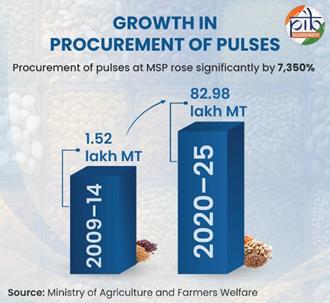
The policy is now increasingly aligned with nutritional and strategic goals. Higher MSPs and assured procurement for pulses, oilseeds, and nutri-cereals (Shree Anna) aim to correct historical biases toward rice-wheat systems. Notably, the government has committed to 100% procurement of pulses (tur, urad, masoor) till 2028–29, marking a decisive push towards import substitution and self-reliance.
Institutionally, MSP procurement is supported through a network of agencies such as the Food Corporation of India, NAFED, and Cotton Corporation of India, ensuring coverage across commodities.
A significant reform dimension is the integration of digital platforms. Tools like e-Samriddhi, e-Samyukti, and Kapas Kisan App are enhancing transparency, reducing intermediaries, enabling direct benefit transfer (DBT), and improving efficiency in procurement operations. This marks a shift toward technology-driven governance in agriculture.
The MSP ecosystem is further strengthened by schemes like Pradhan Mantri Annadata Aay Sanrakshan Abhiyan (PM-AASHA), particularly its Price Support Scheme (PSS), which triggers procurement when market prices fall below MSP.
Despite these achievements, structural concerns persist. MSP benefits remain concentrated in certain regions and crops, particularly wheat and rice belts, limiting its inclusivity. Additionally, rising procurement and subsidy burdens raise fiscal sustainability concerns, while excessive MSP reliance may distort cropping patterns and strain natural resources.
Overall, MSP is transitioning from a defensive policy (income protection) to an offensive strategy (self-sufficiency, diversification, and modernization) in Indian agriculture.
Key Highlights (Data Snapshot)
| Indicator | Earlier Period | Recent Period |
|---|---|---|
| Foodgrain Procurement | 761.40 LMT (2014–15) | 1,175 LMT (2024–25) |
| MSP Payments | ₹1.06 lakh crore | ₹3.33 lakh crore |
| Beneficiary Farmers | — | 1.84 crore |
| Wheat MSP Margin | — | 109% |
| RMS 2026–27 Procurement | — | 297 LMT |
| Expected MSP Payout | — | ₹84,263 crore |
Implications
- Income Stability: Strengthens farmer income security through assured pricing
- Self-Sufficiency: Push for pulses and oilseeds reduces import dependence
- Crop Diversification: Encourages shift toward nutri-cereals and sustainable crops
- Technological Transformation: Digital platforms ensure efficiency and transparency
- Fiscal Burden: Rising MSP procurement increases food subsidy expenditure
- Regional Imbalance: Benefits remain skewed toward procurement-intensive states
- Environmental Concerns: Overproduction of certain crops may stress water and soil resources
Static Part
Commission for Agricultural Costs and Prices (CACP)
- Established: 1965 (renamed in 1985)
- Parent Ministry: Ministry of Agriculture & Farmers Welfare
- Function:
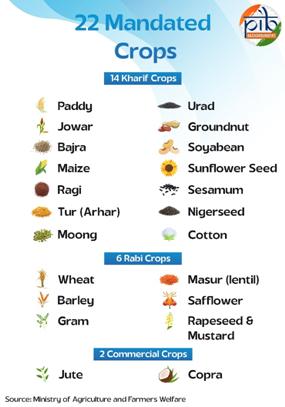
- Recommends MSP for 22 crops and FRP for sugarcane
- Considers cost of production, demand-supply, inter-crop parity
- Promotes balanced price policy and resource use
Pradhan Mantri Annadata Aay Sanrakshan Abhiyan (PM-AASHA)
- Objective: Ensure remunerative prices to farmers
- Key Component: Price Support Scheme (PSS)
- Procurement Agencies:
- NAFED
- National Cooperative Consumers Federation
- Continuation: Approved till 2025–26 (15th Finance Commission cycle)
Procurement Agencies (Commodity-wise)
- Foodgrains: Food Corporation of India
- Cotton: Cotton Corporation of India
- Jute: Jute Corporation of India
Updated - 10 October 2025 ; 12:55 PM | PIB