BASIC ELECTRICAL ENGINEERING MATERIALS, MAGNETIC CIRCUITS AND SEMICONDUCTOR DEVICES
MAGNETIC FLUX AND RELUCTANCE
Magnetic Flux (Φ) is the total magnetic field passing through a given area and is measured in Weber (Wb). In a magnetic circuit, flux represents the quantity of magnetic field lines established through the magnetic path.Reluctance (ℜ) is the opposition offered by a magnetic circuit to the flow of magnetic flux. It is analogous to electrical resistance in an electric circuit and determines how easily magnetic flux can be established within a magnetic path.The reluctance of a magnetic circuit is given by:
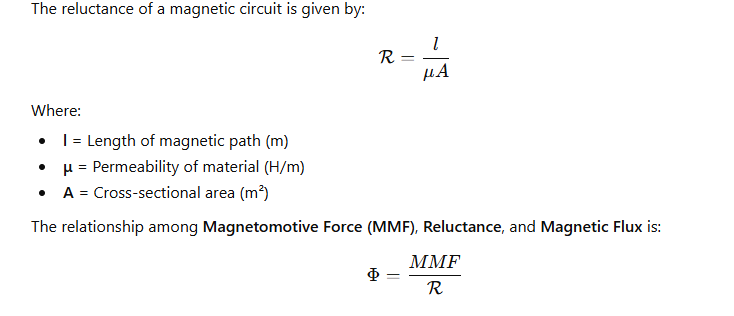
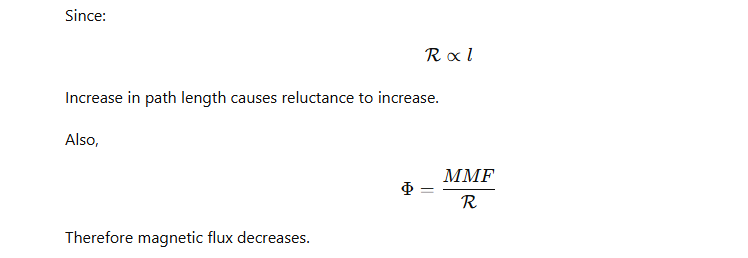
An increase in the length of the magnetic path increases reluctance because reluctance is directly proportional to length. Since magnetic flux is inversely proportional to reluctance, increasing the path length results in a decrease in magnetic flux when MMF and cross-sectional area remain constant.
Example
A magnetic circuit has constant MMF and cross-sectional area. If the length of the magnetic path is increased, determine the effect on magnetic flux.Solution:
HIGH PERMEABILITY IN MAGNETIC MATERIALS
Permeability (μ) is the property of a magnetic material that indicates its ability to support the formation of magnetic flux. Materials having high permeability allow magnetic field lines to pass through them more easily and therefore are preferred in magnetic circuits.The reluctance of a magnetic material is given by:
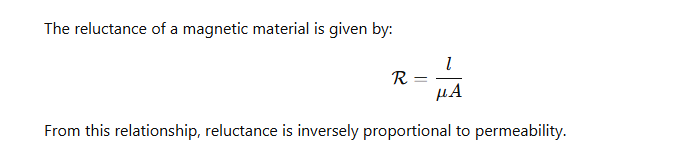
]From this relationship, reluctance is inversely proportional to permeability.A material possessing high permeability offers less opposition to magnetic flux and hence exhibits lower reluctance. This characteristic is highly desirable in transformer cores, inductors, and other electromagnetic devices where efficient magnetic flux transfer is required.
Key Point
- High permeability → Low reluctance
- Low permeability → High reluctance
Example
A magnetic material has very high permeability. What will be its effect on reluctance?Answer: Reluctance decreases.
SOFT MAGNETIC MATERIALS
A soft magnetic material is a material that is easily magnetized when an external magnetic field is applied and loses its magnetism rapidly when the field is removed.Such materials possess:
- Low coercivity
- Low retentivity
Because of these properties, soft magnetic materials are widely used where temporary magnetization is required.
Applications
- Transformer cores
- Electromagnets
Related Terms
| Material Type | Characteristic |
|---|---|
| Soft Magnetic Material | Easily magnetized and demagnetized |
| Hard Magnetic Material | Retains magnetism permanently |
| Ferromagnetic Material | Shows strong magnetic properties |
| Permanent Magnet | Made from hard magnetic materials |
THERMOCOUPLES
A thermocouple is a temperature measuring device that operates on the Seebeck Effect, according to which an electromotive force (EMF) is generated when two dissimilar metals are joined and subjected to a temperature difference.The selection of thermocouple materials determines its accuracy, temperature range, durability, and stability.A commonly used thermocouple employs Copper and Nickel-based alloys (Constantan).
Advantages of Copper–Constantan Thermocouple
- High thermoelectric sensitivity
- High measurement accuracy
- Excellent stability
- Corrosion resistance
- Cost effectiveness
- Suitable for low-temperature applications
Temperature Range
-200°C to 350°C
Example
Which materials are commonly used in a Type-T thermocouple?Answer: Copper and Constantan (Nickel alloy).
TUNGSTEN AS FILAMENT MATERIAL
Tungsten is extensively used in electric lamp filaments and electrodes because of its ability to withstand extremely high temperatures.
Important Properties
- Extremely high melting point (~3422°C)
- High resistance to thermal shock
- Can withstand rapid temperature changes
These properties make tungsten suitable for electrical components operating at elevated temperatures.
ARTIFICIAL MAGNETS
Artificial magnets are man-made magnets specifically designed to possess desired magnetic properties for industrial and electrical applications.
Ceramic Magnets (Ferrite Magnets)
Ceramic magnets are widely used because they provide:
- High magnetic stability
- Resistance to demagnetization
- Cost effectiveness
- Corrosion resistance
- Wide operating temperature range
Applications
- Electrical motors
- Transformers
- Sensors
- Electromagnetic devices
Example
Which artificial magnet is commonly used in motors and transformers?Answer: Ceramic (Ferrite) Magnet.
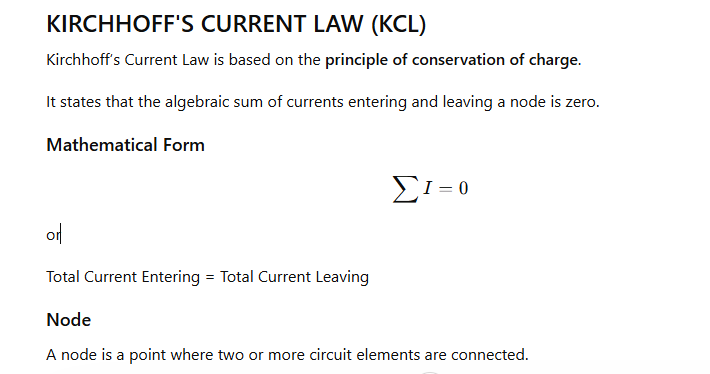
KIRCHHOFF'S CURRENT LAW (KCL)
NICKEL–IRON BATTERY
A Nickel-Iron (Ni-Fe) Battery is a rechargeable battery using:
| Electrode | Material |
|---|---|
| Positive Electrode | Nickel Oxide Hydroxide |
| Negative Electrode | Iron |
| Electrolyte | Potassium Hydroxide (KOH) |
During discharge, chemical reactions occur at both electrodes, producing electric current through electron transfer.
Positive Electrode Reaction
Nickel hydroxide reacts with hydroxide ions and forms nickel oxyhydroxide and water.
Key Point
The conversion of nickel compounds at the positive electrode is an essential part of battery discharge.
COMPOSITE MAGNETIC CIRCUITS
A composite magnetic circuit consists of more than one magnetic material having different permeabilities.Each material contributes its own reluctance to the magnetic path.The total reluctance is equal to the sum of individual reluctances:[
RT=R1+R2+R3+⋯
]This is analogous to resistors connected in series in an electrical circuit.
Important Point
- Higher permeability → Lower reluctance
- Lower permeability → Higher reluctance
Example
How is total reluctance determined in a composite magnetic circuit?Answer: By adding the reluctances of all materials.
ENERGY BAND STRUCTURE OF SEMICONDUCTORS
The electrical behavior of a semiconductor is determined by the energy gap between the Valence Band and the Conduction Band.
Silicon and Germanium
| Semiconductor | Band Gap |
|---|---|
| Silicon (Si) | 1.1 eV |
| Germanium (Ge) | 0.67 eV |
Silicon has a larger band gap than germanium. Consequently, silicon exhibits better thermal stability and is more suitable for modern electronic devices.
Important Observation
- Larger band gap → Better thermal stability
- Smaller band gap → Higher conductivity
P-TYPE SEMICONDUCTORS AND TEMPERATURE
In a P-type semiconductor, holes act as the majority charge carriers.As temperature increases:
- More acceptor atoms become ionized.
- More electrons move to the conduction band.
- Additional electron-hole pairs are generated.
As a result, the number of holes increases and conductivity rises.
Key Point
Increasing temperature increases hole concentration in P-type semiconductors.
MEASUREMENT ERRORS
Measurement errors affect the accuracy and precision of instruments.
Systematic Error
Systematic errors are consistent and repeatable errors causing measurements to deviate in a predictable direction.
Causes
- Improper calibration
- Environmental influences
- Defective measuring methods
Effect
Reduces accuracy.
Random Error
Random errors vary unpredictably from one measurement to another.
Effect
Reduces precision.
Instrumental Drift
Instrument calibration changes gradually with time, producing systematic errors.
Gross Error
Gross errors are human mistakes such as:
- Wrong reading
- Wrong calculations
- Improper instrument usage
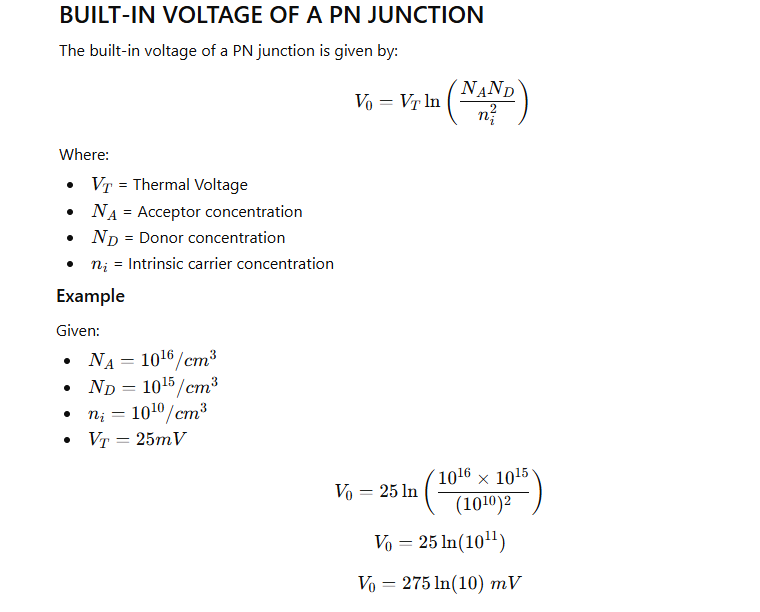
BUILT-IN VOLTAGE OF A PN JUNCTION
STRAIN GAUGES
A strain gauge measures mechanical deformation by detecting changes in electrical resistance.The relation between strain and resistance is:
ΔR=kεR
Where:
- ΔR = Change in resistance
- k = Gauge factor
- ε = Strain
- R = Original resistance
Principle
When a material deforms, the electrical resistance of the strain gauge changes proportionally.
Key Point
Strain gauges primarily measure changes in resistance.
EPOXY RESIN
Epoxy resin is a thermosetting polymer widely used in electrical engineering because of its excellent insulation and mechanical properties.
Important Properties
- Excellent electrical insulation
- High thermal stability
- High chemical resistance
- High mechanical strength
- Moisture resistance
These characteristics make epoxy resin suitable for high-performance electrical applications.
BATTERY AGING
Battery aging refers to the gradual loss of a battery's ability to store and deliver charge over time.It involves irreversible chemical and physical changes inside the battery.
Effects
- Reduced charge holding capacity
- Performance degradation
- Reduced service life
Battery aging is also known as:
- Battery degradation
- Capacity fade
NPN TRANSISTOR IN AMPLIFICATION
An NPN transistor consists of:
- Emitter
- Base
- Collector
In active mode, the emitter injects electrons into the base region.The base is thin and lightly doped, causing only a small fraction of electrons to recombine within it.Most electrons reach the collector region, enabling current amplification.
Important Feature
Very few charge carriers from the emitter recombine in the base region.This property enables high current gain and efficient signal amplification.
SEMICONDUCTOR MATERIALS
A semiconductor possesses electrical conductivity between that of conductors and insulators.Its conductivity can be controlled through:
- Temperature
- Light
- Doping
Types
| Type | Description |
|---|---|
| Intrinsic Semiconductor | Pure semiconductor |
| Extrinsic Semiconductor | Doped semiconductor |
Characteristics
- Possesses a finite band gap
- Conductivity varies with external conditions
- Shows negative temperature coefficient
Applications
- Diodes
- Transistors
- Integrated Circuits
- Solar Cells
- LEDs
- Communication Devices
Key Definition
A semiconductor is a material that can conduct electricity under certain conditions but not under others.
HYDROGEN AS INSULATING AND COOLING GAS
Hydrogen is used in large electrical equipment such as generators because of its excellent insulating and cooling properties.
Important Characteristics
- High dielectric strength
- Low molecular weight
- High thermal conductivity
- Low density
These properties allow hydrogen to provide effective insulation while simultaneously removing heat efficiently from electrical equipment.
MAGNETIC FIELDS, MAGNETIC CIRCUITS, TRANSMISSION MEDIA, ELECTRICAL MATERIALS AND MEASUREMENT CONCEPTS
TOROIDAL COIL
A toroidal coil is a coil wound in the form of a closed circular ring or doughnut-shaped structure. The winding is uniformly distributed around the magnetic core, resulting in a highly confined magnetic field. The primary advantage of the toroidal configuration is that the magnetic flux remains concentrated within the core, thereby minimizing magnetic leakage.The operation of a toroidal coil is explained by Ampere's Circuital Law, which states that the line integral of magnetic field intensity around a closed path is equal to the current enclosed by that path. The magnetic field produced inside the toroid is circular in nature and remains confined within the magnetic core. Owing to the symmetrical distribution of windings, the magnetic field contributions outside the toroid cancel each other. As a result, the net magnetic field outside the toroidal coil becomes zero.
Important Points
- Magnetic field inside toroid → Present and confined within the core
- Magnetic field outside toroid → Zero
MAGNETIC CIRCUITS AND RELUCTANCE
A magnetic circuit is a closed path through which magnetic flux flows. Magnetic materials having high permeability are employed to provide an efficient path for the magnetic flux.Reluctance (ℜ) is the opposition offered by a magnetic circuit to the establishment of magnetic flux. It is analogous to electrical resistance in an electrical circuit. The magnetic flux in a magnetic circuit depends directly on the magnetomotive force and inversely on the reluctance.[
Φ=MMF/R
]When the magnetomotive force remains constant, an increase in reluctance causes a decrease in magnetic flux. Similarly, a decrease in reluctance results in an increase in magnetic flux.In a series magnetic circuit, the magnetic flux remains the same throughout the entire path. Therefore, if the reluctance of any section increases, the total reluctance of the circuit increases and the overall magnetic flux decreases.
Important Points
- Increase in reluctance → Decrease in flux
- Decrease in reluctance → Increase in flux
MAGNETIC FIELD INSIDE A SOLENOID
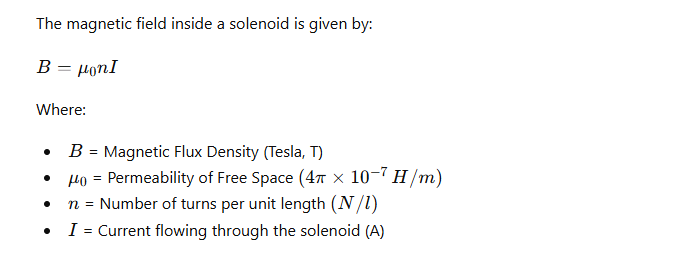
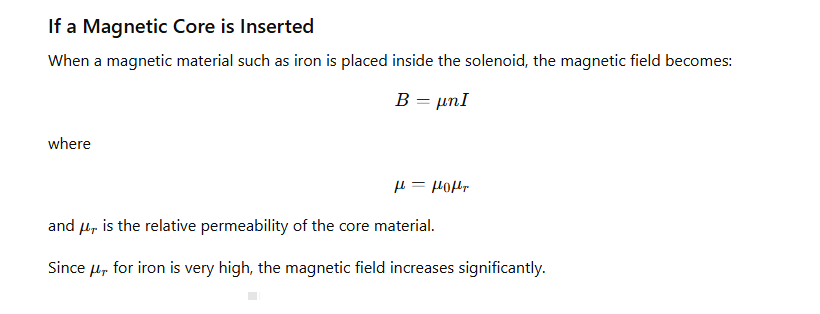
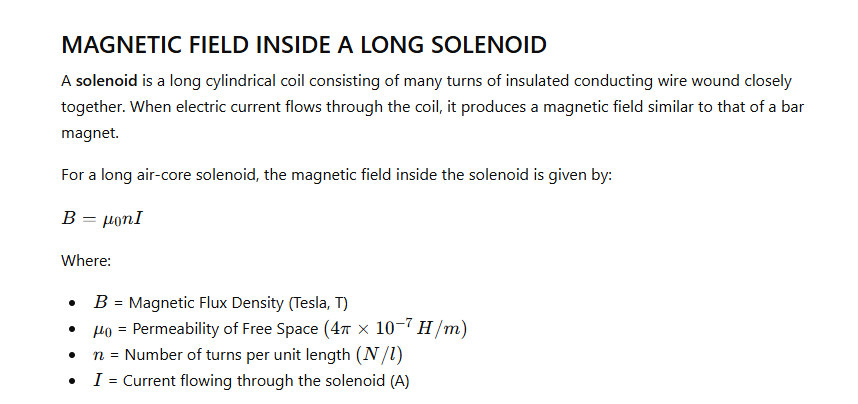
A solenoid is a long helical coil of conducting wire that produces a magnetic field when an electric current flows through it. The magnetic field inside a long solenoid is strong, nearly uniform, and directed along its axis.The magnetic field inside a solenoid is given by:
Characteristics of Magnetic Field in a Solenoid
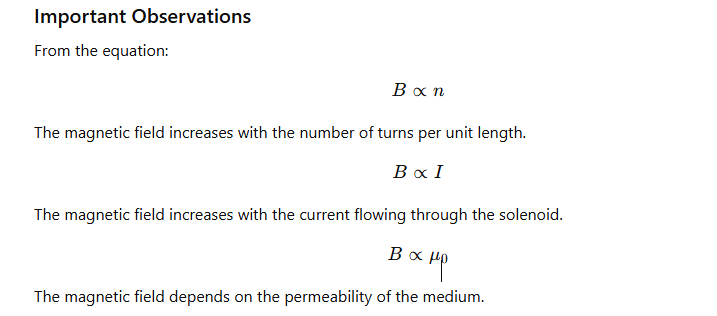
- Magnetic field inside a long solenoid is nearly uniform.
- Field lines inside are straight, parallel, and equally spaced.
- Magnetic field outside the solenoid is very weak.
- One end behaves as a North Pole and the other as a South Pole.
Right-Hand Grip Rule
To determine the direction of the magnetic field:
- Curl the fingers of your right hand in the direction of current flow through the coil.
- The thumb points in the direction of the magnetic field inside the solenoid and towards its North Pole.
MAGNETIC FIELD STRENGTH AND LAPLACE'S LAW
Magnetic Field Strength
The magnetic field strength (H) in a magnetic circuit is directly proportional to the magnetomotive force (MMF) and inversely proportional to the magnetic path length (l).
H=MMF/ L
Where:
- H = Magnetic Field Strength (A/m)
- MMF = Magnetomotive Force (Ampere-turns)
- l = Magnetic Path Length (m)
Note on Laplace's Law
The above relation concerns magnetic field strength in a magnetic circuit. It is not Laplace's Law.Laplace's Law (Electromagnetism) gives the force on a current-carrying conductor placed in a magnetic field:
F=BIlsinθ
where:
- F = Force on conductor (N)
- B= Magnetic Flux Density (T)
- I= Current (A)
- l = Length of conductor in magnetic field (m)
- θ = Angle between conductor and magnetic field
Thus, the calculation shown above is based on the magnetic field strength equation, not on Laplace's Law.
FERROMAGNETIC MATERIALS
Ferromagnetic materials possess strong magnetic properties due to the presence of unpaired electrons. These materials can be magnetized easily and continue to retain magnetization even after the removal of the external magnetic field.The retention of magnetization after removal of the external magnetic field is known as hysteresis.
Examples
- Iron
- Nickel
- Cobalt
- Ferromagnetic alloys
Characteristics
- Strong attraction towards magnetic fields
- Retain magnetization after field removal
- Exhibit hysteresis
EDDY CURRENT LOSS
Eddy currents are circulating currents induced within conducting magnetic materials when they are exposed to alternating magnetic fields. These currents generate undesirable heating and energy loss known as eddy current loss.Eddy current loss increases significantly with an increase in material thickness because larger current loops are formed within thicker materials.
Factors Affecting Eddy Current Loss
| Factor | Effect on Eddy Current Loss |
|---|---|
| Thickness of Material | Increases Loss |
| Frequency | Increases Loss |
| Magnetic Flux Density | Increases Loss |
To reduce eddy current losses, laminated magnetic cores are commonly employed.
ELECTRICAL CONDUCTORS AND RESISTIVITY
Resistivity is the property of a material that opposes the flow of electric current.Conductivity is the reciprocal of resistivity.
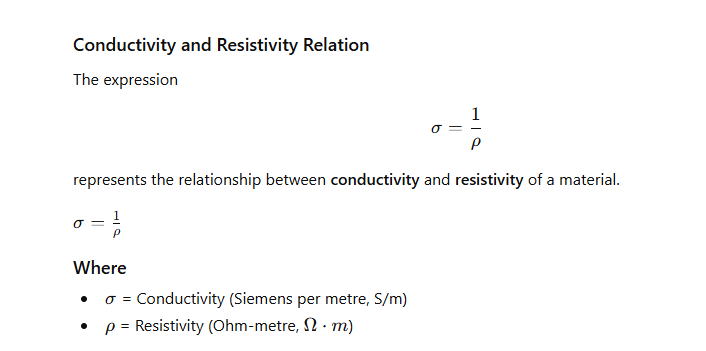
]Materials having low resistivity possess high conductivity and are therefore preferred for electrical conductors.
Examples
- Copper
- Aluminium
- Silver
Characteristics
- High electrical conductivity
- Reduced power loss
- Efficient current transmission
ANNEALING OF CONDUCTING MATERIALS
Annealing is a heat-treatment process that involves heating a material to a suitable temperature followed by slow cooling.The annealing process consists of three stages:
- Recovery
- Recrystallization
- Grain Growth
Annealing reduces internal stresses and decreases the number of dislocations present within the material. Since dislocations obstruct electron movement, their reduction lowers electrical resistance and improves conductivity.
Effects of Annealing
- Reduced electrical resistance
- Increased ductility
- Reduced hardness
- Reduced tensile strength
- Improved conductivity
Annealed copper and aluminium are extensively used in electrical engineering applications.
MANGANIN
Manganin is an alloy primarily composed of copper, manganese and nickel.
Composition
| Element | Approximate Percentage |
|---|---|
| Copper | 84% |
| Manganese | 12% |
| Nickel | 4% |
The most important property of manganin is its low temperature coefficient of resistance. This property enables its resistance value to remain nearly constant over a wide range of temperatures.
Applications
- Precision resistors
- Strain gauges
- Temperature-sensitive instruments
ACCURACY IN MEASUREMENTS
Accuracy refers to the closeness of a measured value to the true or accepted value. A highly accurate measurement exhibits very little deviation from the actual value.Accuracy is mainly affected by systematic errors.
Important Distinctions
| Quantity | Meaning |
|---|---|
| Accuracy | Closeness to true value |
| Precision | Repeatability of measurement |
| Resolution | Smallest detectable change |
PIEZOELECTRIC TRANSDUCERS
A piezoelectric transducer operates on the piezoelectric effect, according to which mechanical stress applied to certain materials produces an electrical output.When mechanical force deforms the crystal structure, electric charges are displaced and a voltage is generated across the material.
Principle
Mechanical Stress → Electrical Voltage
Characteristics
- Converts mechanical energy into electrical energy
- Voltage proportional to applied stress
- Suitable for sensing applications
INSULATION RESISTANCE
Insulation resistance represents the ability of an insulating material to resist leakage current.Among various influencing factors, temperature is the most significant. As temperature increases, thermal agitation and charge carrier concentration increase, resulting in a reduction in insulation resistance.
Important Point
Temperature and insulation resistance are inversely related.
INSULATING MATERIALS
Glass
Glass is widely used as an insulating material because of its high dielectric strength, moisture resistance, chemical resistance and thermal stability.
Applications
- High-voltage switchgear
- Transformer bushings
- Transmission line insulators
Nitrogen Gas
Nitrogen is extensively used as an insulating gas in electrical equipment because of its favorable insulating characteristics.
Characteristics
- Non-flammable
- Chemically inert
- Good dielectric strength
- Cost-effective
- Environmentally safe
These properties make nitrogen suitable for electrical insulation applications.
TRANSMISSION MEDIA
Transmission media are classified into guided and unguided transmission systems. Guided transmission media transfer signals through a physical path.
Optical Fibre
Optical fibre consists of two concentric glass layers known as the core and the cladding. The refractive index of the core is greater than that of the cladding.[
n1>n2
]Light propagates through the optical fibre on the principle of Total Internal Reflection.
Characteristics
- Very low transmission loss
- High communication efficiency
- Suitable for voice, image and data transmission
UNSHIELDED TWISTED PAIR (UTP)
UTP cables consist of twisted conductor pairs without additional shielding.
Advantages
- Lower cost
- Easy installation
- Lightweight
- Flexible
However, UTP cables are more susceptible to electromagnetic interference than shielded cables.
COAXIAL CABLE
A coaxial cable consists of the following components:
- Core conductor
- Dielectric insulator
- Metallic shield
- Outer jacket
The metallic shield performs an important role in protecting the signal from electromagnetic interference (EMI).
Functions of Metallic Shield
- EMI protection
- Signal containment
- Grounding support
OVERHEAD TRANSMISSION CONDUCTORS
AAC (All Aluminium Conductor)
AAC consists entirely of aluminium conductors and provides high electrical conductivity.
AAAC (All Aluminium Alloy Conductor)
AAAC consists of aluminium alloy conductors and offers improved mechanical performance.
Comparison of AAC and AAAC
| Property | AAC | AAAC |
|---|---|---|
| Material | Pure Aluminium | Aluminium Alloy |
| Mechanical Strength | Lower | Higher |
| Corrosion Resistance | Lower | Higher |
| Conductivity | Higher | Lower than AAC |
| Cost | Lower | Slightly Higher |
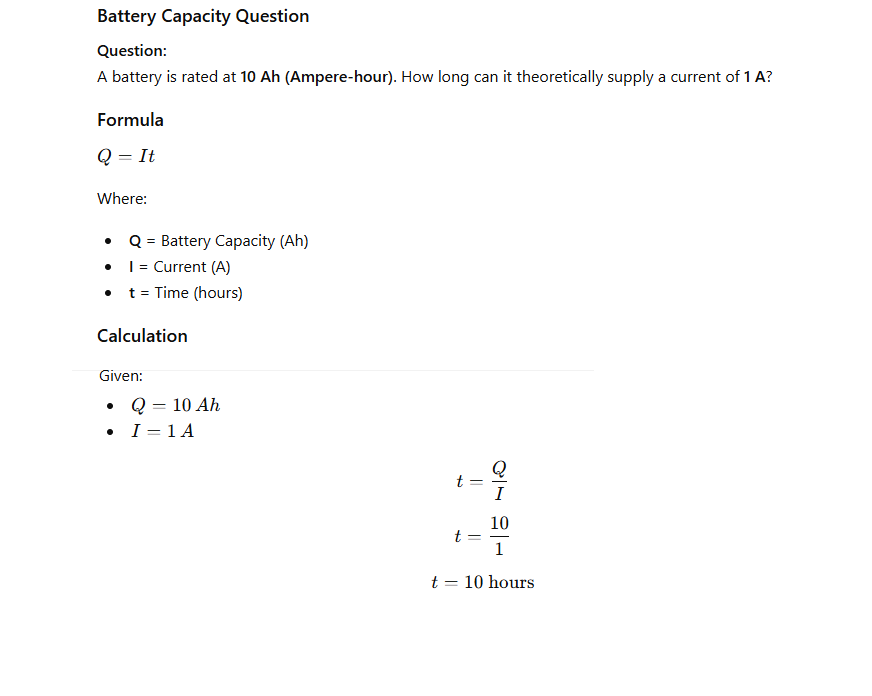
BATTERY CAPACITY
Battery capacity refers to the total amount of electrical charge that a battery can store and deliver under specified operating conditions. It is generally expressed in Ampere-Hour (Ah).A battery having a higher ampere-hour rating can deliver current for a longer duration under specified conditions.
NUMERICALS
RESISTANCE, RESISTIVITY AND CONDUCTIVITY OF A CONDUCTOR
The resistance of a conductor increases with an increase in temperature. Resistance depends upon both the resistivity and the physical dimensions of the conductor.The variation of resistivity with temperature is given by:[
ρ(T)=ρ0[1+α(T−T0)
where ρ(T) is the resistivity at temperature T, ρ₀ is the resistivity at standard temperature T₀, and α is the temperature coefficient of resistivity.Conductivity is the reciprocal of resistivity. Therefore, when resistivity increases, conductivity decreases, and vice versa.
SEMICONDUCTORS
A semiconductor is a material whose electrical properties lie between those of conductors and insulators.The resistance of a semiconductor decreases as temperature increases. With increasing temperature, additional electrons acquire sufficient energy to become free for conduction. As a result, conductivity increases while resistance decreases.At absolute zero temperature, a semiconductor behaves as a perfect insulator.Semiconductors possess a negative temperature coefficient of resistivity, meaning that their resistance decreases with an increase in temperature.
EFFECT OF HARDENING ON ELECTRICAL MATERIALS
Hardening processes such as cold working or alloying increase the dislocation density within a material.The increased number of dislocations obstructs the movement of electrons, thereby reducing electrical conductivity. Simultaneously, the material becomes more brittle because of the introduction of defects and microstructural changes.Effect of Hardening:
- Reduced electrical conductivity
- Increased brittleness
MAGNETIC FRINGING
Magnetic fringing occurs near the ends of a magnetic circuit where magnetic field lines spread outward into the surrounding air instead of remaining confined to the magnetic path.Since air offers a lower confinement to magnetic flux, the magnetic field lines diverge at the edges. This spreading causes the magnetic field to become weaker near the boundaries and leads to flux leakage.Result of Magnetic Fringing:
- Magnetic field lines spread outward
- Magnetic field strength near the edges decreases
DIAMAGNETIC MATERIALS
Diamagnetic materials produce an induced magnetic field that opposes an externally applied magnetic field. Consequently, they experience a weak repulsive force in the presence of a magnetic field.Diamagnetism arises because orbiting electrons generate tiny current loops whose magnetic fields oppose the applied magnetic field.
Characteristics
- Weakly repelled by magnetic fields
- Induced magnetic field opposes the external field
- Negative magnetic susceptibility
- Magnetization occurs opposite to the applied field direction
Examples
- Bismuth
- Copper
- Gold
- Silicon
- Water
Diamagnetic materials exhibit a definite response to magnetic fields and are therefore neither unaffected by magnetic fields nor attracted to them.
APPLICATION OF CARBON IN ELECTRICAL ENGINEERING
Carbon is extensively used for manufacturing electrical contacts and brushes in motors.Carbon brushes provide an effective conducting path between stationary and rotating parts of electrical machines.
Advantages of Carbon Brushes
Good Electrical ConductivityCarbon provides efficient transfer of electrical current between moving and stationary components.Self-Lubricating PropertyCarbon reduces friction and wear between the brush and commutator, increasing service life.Heat ResistanceCarbon can withstand high operating temperatures generated by friction and current flow.Low Coefficient of Thermal ExpansionDimensional stability is maintained even under varying temperatures.Adequate Mechanical StrengthCarbon brushes can withstand operational pressures and mechanical forces.Because of these properties, carbon brushes are widely used in DC motors, synchronous motors, and induction motors.
THERMISTORS
A thermistor is a temperature-sensitive resistor widely used for temperature measurement and sensing applications.
Major Advantages
High SensitivityThermistors exhibit large resistance changes even for small temperature variations.Fast Response TimeTheir small size and low thermal mass enable rapid response to temperature changes.Cost EffectivenessThermistors are economical and provide high accuracy over limited temperature ranges.
Comparison of Temperature Sensors
| Sensor | Sensitivity | Response Time | Linearity | Temperature Range |
|---|---|---|---|---|
| Thermistor | Very High | Fast | Non-linear | Limited |
| RTD | Moderate | Slow | Linear | Wide |
| Thermocouple | Low | Fast | Quasi-linear | Very Wide |
MICROWAVE COMMUNICATION
Microwaves are electromagnetic waves having frequencies approximately between 300 MHz and 300 GHz.In unguided communication systems, microwaves propagate in straight lines and therefore require line-of-sight transmission.A direct and unobstructed path must exist between transmitting and receiving antennas. Obstacles such as buildings, hills, and heavy rainfall can attenuate or block microwave signals.
Important Characteristic
Microwave communication requires line-of-sight transmission.
SELECTIVITY OF PROTECTIVE RELAYS
Selectivity is the ability of a protection system to isolate only the faulty section while keeping the healthy portions of the power system in service.A selective relay system ensures that the appropriate circuit breaker operates to disconnect the faulted section without disturbing the remainder of the network.
Significance
- Faulty section is isolated accurately
- Healthy system continues operation
- Unnecessary outages are prevented
DIELECTRIC STRENGTH
Dielectric strength is the maximum electric field or voltage per unit thickness that an insulating material can withstand without undergoing electrical breakdown.It is generally expressed in:
- kV/mm
- V/mil
When the dielectric strength is exceeded:
- Insulating property is lost
- Current begins to flow through the material
- Dielectric breakdown occurs
Definition
Dielectric Strength = Maximum voltage a dielectric material can withstand without breakdown
COPPER AS AN ELECTRICAL CONDUCTOR
Copper is one of the most widely used electrical conductors because of its excellent electrical and mechanical properties.
Advantages
High Electrical ConductivityCopper possesses extremely high conductivity, second only to silver among pure metals.Corrosion ResistanceCopper forms a protective oxide layer that inhibits further corrosion.Economic ViabilityCopper provides an excellent balance between conductivity, durability, and cost.Because of these characteristics, copper is preferred for electrical conductors in power and industrial applications.
MINERAL INSULATORS
Mineral insulating materials such as porcelain and glass are extensively used as electrical insulators for high-voltage transmission lines.
Reasons
High Mechanical StrengthThey can withstand conductor loads, wind forces, and mechanical stresses.Excellent Electrical InsulationThey possess high dielectric strength and can withstand very high operating voltages without breakdown.These properties ensure safe and reliable power transmission.
MAGNETIC FIELD
A magnetic field is the region surrounding a magnet or a current-carrying conductor where magnetic forces can act on magnetic materials, magnets, or moving charges.Magnetic fields are represented by magnetic field lines that indicate both magnitude and direction.
Characteristics
- Magnetic field is a vector quantity.
- Field lines never intersect.
- Field lines form closed loops.
- Field strength decreases with distance.
N-TYPE SEMICONDUCTOR
An N-type semiconductor is formed by doping a pure semiconductor with a pentavalent impurity containing more valence electrons than the host semiconductor.The additional electrons supplied by the dopant become free electrons and act as majority charge carriers.After donating their extra electrons, dopant atoms become immobile positive ions fixed within the crystal lattice.
Characteristics
- Majority carriers are electrons.
- Minority carriers are holes.
- Positive ions remain fixed and immobile.
- Conductivity increases due to excess free electrons.
DISTANCE RELAY
A distance relay is a protective relay used primarily for transmission-line protection.Its operation is based on the impedance measured between the relay location and the fault location.The relay continuously measures voltage and current and calculates impedance using:[
Z=V/I
]When the measured impedance falls within a predetermined protection zone, the relay identifies a fault and initiates tripping.
Operating Principle
Distance relay operates on the basis of impedance between the relay and the fault.
NICKEL–IRON (Ni–Fe) CELL DURING DISCHARGING
A Nickel–Iron cell consists of:
- Positive electrode: Nickel oxide hydroxide
- Negative electrode: Iron
During discharging:
Positive Electrode Reaction
Nickel oxide hydroxide is reduced to nickel hydroxide.
Negative Electrode Reaction
Iron is oxidized to iron hydroxide.The electrochemical reactions produce electrical energy that is supplied to the external circuit.
Overall Observation
- Iron at the negative electrode undergoes oxidation.
- Nickel compound at the positive electrode undergoes reduction to nickel hydroxide.
Nickel–Iron cells are commonly used in renewable energy systems, railway signaling, and emergency power applications where long service life is required.
RESISTOR RATING
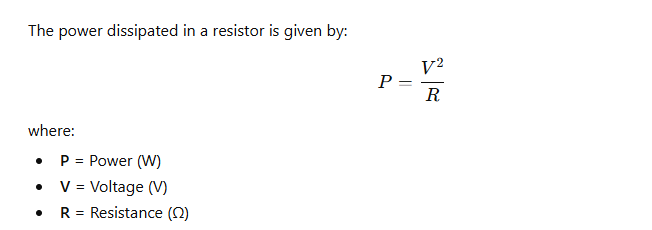
The rating of a resistor is primarily determined by its power dissipation capacity.Power rating specifies the maximum power that a resistor can safely dissipate without overheating or sustaining damage.The power dissipated in a resistor is given by:
Importance of Power Rating
- Prevents overheating
- Ensures reliability
- Increases component life
- Maintains safe operation of circuits
Key Point
The primary factor determining the rating of a resistor is its power dissipation capacity.