BUILDING A VIKSIT BHARAT WITH 6G
BUILDING A VIKSIT BHARAT WITH 6G
Introduction
India is rapidly positioning itself as a major global player in the development of 6G telecommunications technology through a combination of indigenous innovation, strategic research initiatives, international collaborations, and policy-driven technological self-reliance. Anchored in the broader vision of Viksit Bharat 2047, India’s 6G roadmap aims to transform the country from a technology adopter into a global telecom innovator and standard-setter.The government’s approach focuses on the principles of affordability, sustainability, and ubiquity, while simultaneously promoting advanced R&D, startup ecosystems, telecom manufacturing, and digital inclusion.
WHAT IS 6G?
6G (Sixth Generation Wireless Technology) will succeed 5G and is expected to provide:
- Ultra-high-speed connectivity
- Extremely low latency
- Massive machine-to-machine communication
- AI-integrated intelligent networks
- Real-time immersive digital experiences
The article highlights that 6G aims to achieve response times of nearly:
- 1 microsecond
- Around 1,000 times faster than 5G latency
KEY FEATURES OF 6G TECHNOLOGY
Ultra-Low Latency
Near-instantaneous communication will enable:
- Remote robotic surgeries
- Autonomous transportation
- Industrial automation
- Real-time AI systems
AI-Integrated Networks
6G networks are expected to integrate Artificial Intelligence for:
- Intelligent data routing
- Dynamic network optimization
- Automated decision-making
- Smart edge computing
Advanced Imaging and Virtual Experiences
6G will support:
- Holographic communication
- Immersive virtual reality
- High-precision location tracking
- Spatial computing ecosystems
BHARAT 6G VISION
The Bharat 6G Vision document was released on:
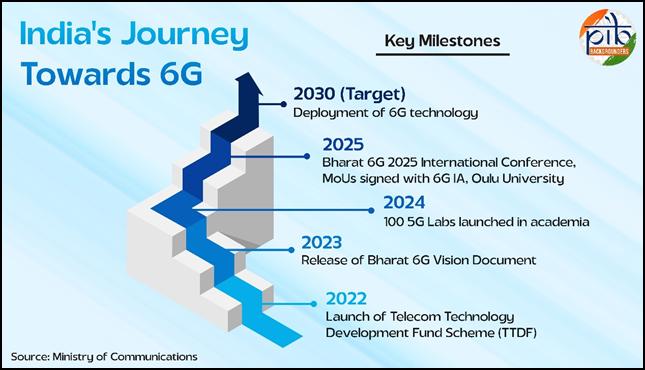
- 22 March 2023
The vision aims to position India as:
- A frontline contributor in:
- Design
- Development
- Deployment of 6G technologies by 2030
The roadmap aligns with:
- Digital India
- Make in India
- Atmanirbhar Bharat
- Viksit Bharat 2047
GOVERNMENT INITIATIVES FOR 6G DEVELOPMENT
1. 6G Testbeds
The Government has funded:
- 6G THz Testbed
- Advanced Optical Communication Testbed
Purpose:
- Promote indigenous R&D
- Build telecom innovation capacity
- Develop next-generation communication systems
2. 100 Academic 5G Labs
The Government sanctioned:
- 100 5G Labs
- Across academic institutions in FY 2023–24
Objectives include:
- 5G and 6G skill development
- Startup ecosystem support
- Industry-academia collaboration
- Telecom experimentation and innovation
3. Research Ecosystem
The article highlights:
- 104 research proposals approved
- Focused on:
- 6G network ecosystems
- Telecom innovation
- Global 6G roadmap alignment
BHARAT 6G ALLIANCE (B6GA)
The Bharat 6G Alliance is a major institutional mechanism driving India’s 6G ecosystem.
Nature
Industry-led collaborative platform involving:
- Telecom companies
- Academia
- Research institutions
- Standards organizations
- Startups
Major Focus Areas
The alliance has created working groups on:
- Spectrum
- Technology
- Applications
- Sustainability
- Green telecom systems
- Use cases
Global Collaborations
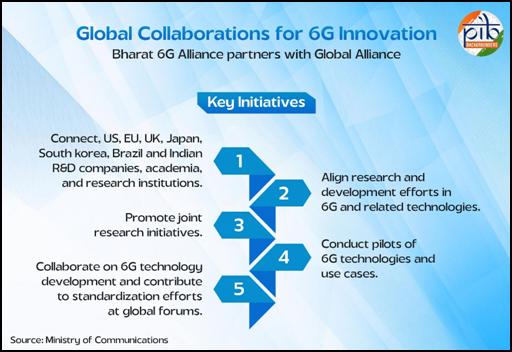
B6GA has signed MoUs with several international organizations including:
- NextG Alliance (USA)
- 6G IA (Europe)
- Oulu University (Finland)
- 6G Forum South Korea
- XGMF Japan
- ESA (European Space Agency)
- 6G Brasil
Importance:
- Global standardization
- Joint R&D
- Secure telecom ecosystems
- Trusted supply chains
INDIA’S 6G ECONOMIC POTENTIAL
India’s 6G roadmap projects:
- Telecom sector contribution of nearly:
- USD 1.2 trillion to GDP by 2035
India also aims to secure:
- 10% of global 6G patents
This reflects ambitions to emerge as a global telecom innovation hub.
INDIA MOBILE CONGRESS 2025
The International 6G Symposium 2025, held during India Mobile Congress (IMC) 2025, highlighted India’s growing telecom leadership.Key themes included:
- Indigenous telecom systems
- Secure communication networks
- Inclusive digital ecosystems
- International cooperation
KEY ANNOUNCEMENTS AT IMC 2025
Joint Declaration on 6G Principles
Released on:
- 10 October 2025
Whitepapers Released by Bharat 6G Alliance
Important whitepapers included:
- Spectrum Roadmap for 6G in India
- Powering Next-Gen Telecom
- AI and Network Evolution to 5G
- 6G Architecture, Security and Exposure Framework for RF Sensing
These documents provide strategic direction for future telecom policy and R&D.
TELECOM TECHNOLOGY DEVELOPMENT FUND (TTDF)
Launch
- Launched:
- 1 October 2022
Objectives
Supports:
- Telecom R&D
- Indigenous innovation
- Rural connectivity technologies
- Startup and MSME participation
Key Data
- 115 projects related to 5G and 6G
- Funding approved:
- Rs. 310.6 crore
- Projects duration:
- 1–5 years
TECHNOLOGY INNOVATION HUB AT IIIT-BANGALORE
Established under:
- National Mission on Interdisciplinary Cyber-Physical Systems (NM-ICPS)
Focus areas include:
- Advanced Communication Systems
- Reconfigurable Intelligent Surfaces
- O-RAN Massive MIMO
- 5G+
- 6G systems
Importance:
- Indigenous Intellectual Property creation
- Patent generation
- Telecom standards development
STRATEGIC SIGNIFICANCE OF INDIA’S 6G PUSH
India’s 6G initiatives are strategically important because they can:
- Reduce telecom import dependence
- Strengthen semiconductor ecosystems
- Enhance cybersecurity
- Create global telecom competitiveness
- Improve digital inclusion
- Expand rural connectivity
CHALLENGES
Despite progress, several challenges remain:
- High R&D expenditure requirements
- Semiconductor dependency
- Spectrum management issues
- Cybersecurity threats
- Skilled manpower shortages
- Global standardization competition
NECESSARY STATIC PART
Bharat 6G Vision
- Released:
- 22 March 2023
Objective
- Make India a global leader in 6G technology by 2030
Bharat 6G Alliance (B6GA)
Nature
- Industry-led collaborative telecom platform
Members
- Telecom companies
- Academia
- Startups
- Research institutions
- Standards organizations
Focus
- Indigenous 6G R&D
- Global standardization
- Telecom innovation ecosystem
Telecom Technology Development Fund (TTDF)
- Launched:
- 1 October 2022
Objective
- Promote indigenous telecom R&D
- Encourage startup and academic participation
- Enhance rural broadband technologies
India Mobile Congress (IMC)
Nature
- India’s flagship telecom technology platform
Focus Areas
- 5G
- 6G
- AI
- Digital infrastructure
- Telecom innovation
National Mission on Interdisciplinary Cyber-Physical Systems (NM-ICPS)
Objective
- Promote advanced technology research and innovation
Focus Areas
- AI
- Cyber-physical systems
- Advanced communication technologies
Updated – 26 Oct 2025 ; 02:37 PM | PIB | News Source – PIB Delhi