India–AI Impact Summit 2026 and Global AI Governance
IN NEWS: India–AI Impact Summit 2026 and Global AI Governance
Introduction
The India–AI Impact Summit 2026, announced under the leadership of Narendra Modi, marks a significant global initiative positioning India as a leader in Artificial Intelligence (AI) governance, inclusivity, and Global South representation. Scheduled in New Delhi, the summit brings together global leaders, policymakers, industry experts, and academia to deliberate on AI’s transformative potential and associated challenges.
Centered around the theme “Sarvajan Hitaya, Sarvajan Sukhaya” (Welfare for all, Happiness for all), the summit reflects India’s vision of making AI a tool for inclusive, human-centric, and responsible development.
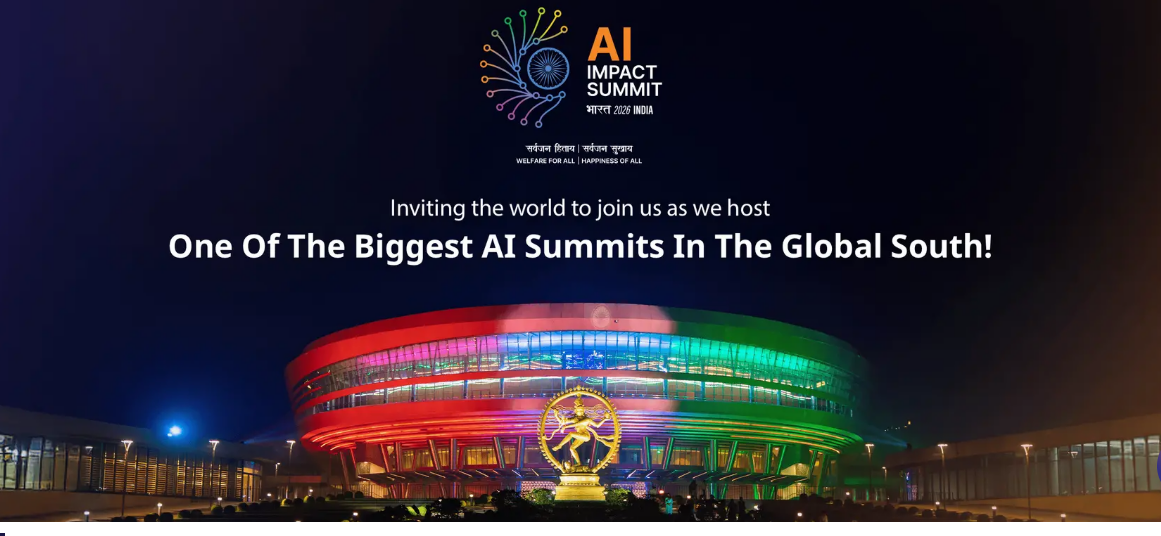
Theme Significance: “Sarvajan Hitaya, Sarvajan Sukhaya”
The theme is rooted in ancient Indian philosophical traditions, emphasizing:
- Universal welfare over selective growth
- Technology as a means for collective good
- Alignment of AI with ethical and societal values
Implication:
Positions India’s AI approach as normative + welfare-oriented, contrasting with purely market-driven AI ecosystems.
ANALYSIS
1. Significance of the Summit in Global Context
The summit represents a shift from dialogue to action in global AI governance. While previous initiatives like G20 AI Principles, UN AI frameworks, and GPAI resolutions focused on normative frameworks, this summit emphasizes:
- Concrete outcomes and implementation frameworks
- Bridging the Global AI Divide
- Enhancing multilateral cooperation
It is particularly significant as:
- First global AI summit hosted in the Global South
- Focuses on inclusive AI development
- Addresses geopolitical imbalance in AI capabilities
2. The Three Foundational Sutras (Core Framework)
The summit is structured around three guiding principles:
| Sutra | Core Idea | Implication |
|---|---|---|
| People | Human-centric AI | Ethical, inclusive, culturally sensitive AI |
| Planet | Sustainable AI | Reduced energy footprint, climate alignment |
| Progress | Inclusive growth | AI for development, equity, access |
These reflect a normative + developmental approach, balancing innovation with responsibility.
3. The Seven Chakras (Operational Domains)
To operationalize the Sutras, 7 priority areas (Chakras) are identified:
- Human Capital
- Inclusion for Social Empowerment
- Safe and Trusted AI
- Resilience, Innovation & Efficiency
- Science
- Democratizing AI Resources
- AI for Economic Growth & Social Good
These domains aim to translate vision into actionable policy frameworks.
4. Key Themes Emerging from the Summit
a) Bridging the Global AI Divide
- AI resources concentrated in few countries and corporations
- Need for equitable access to computing power and datasets
b) AI as Development Multiplier
- Potential to leapfrog development in:
- Healthcare
- Education
- Agriculture
- Governance
c) Risks and Challenges
- Job displacement
- Algorithmic bias
- Rising energy consumption
- Ethical and regulatory concerns
d) Strategic Positioning of India
India aims to:
- Become a global AI hub
- Promote “AI for All”
- Lead Global South voice in tech governance
5. Key Attendees (Illustrative Table)
| Name | Organization | Position |
|---|---|---|
| Sam Altman | OpenAI | CEO |
| Sundar Pichai | Google & Alphabet | CEO |
| Jensen Huang | NVIDIA | Founder & CEO |
| Mukesh D. Ambani | Reliance Industries | Chairman & MD |
| Nandan Nilekani | Infosys | Chairman |
| Arundhati Bhattacharya | Salesforce India | Chairperson & CEO |
| Demis Hassabis | Google DeepMind | CEO |
| Yoshua Bengio | Mila Institute | Founder |
| Yann LeCun | Meta AI | Chief Scientist |
| Tony Blair | Tony Blair Institute | Executive Chairman |
Inference:
- Strong representation from Big Tech, academia, and policymakers
- Reflects multi-stakeholder AI governance model
6. Cultural Dimension of the Summit
The summit integrates technology with cultural diplomacy, highlighting:
- Programme by Sangeet Natak Akademi
- Event: “India’s Journey from Tradition to Technology”
- Nagaland-focused performance by TaFMA
Implication:
- Reinforces India’s soft power + digital civilization narrative
- Aligns AI with cultural identity preservation
7. Governance and Institutional Framework
Key Institutions Involved
| Institution | Role |
|---|---|
| Ministry of Electronics & IT (MeitY) | Nodal ministry |
| IndiaAI Mission | Implementation & coordination |
| NIC (National Informatics Centre) | Digital infrastructure support |
Key Officials
- Ashwini Vaishnaw – Policy direction
- Jitin Prasada – Execution support
- S. Krishnan – Administrative leadership
- Abhishek Singh – Implementation
8. Strategic Implications for India
- Positions India as:
- Global AI policy leader
- Voice of Global South
- Promotes:
- Digital public infrastructure model
- Affordable AI computing access
- Strengthens:
- Tech diplomacy
- Innovation ecosystem
Conclusion
The India–AI Impact Summit 2026 represents a paradigm shift in global AI governance, moving from principles to actionable frameworks. By integrating technology, inclusivity, sustainability, and cultural identity, India is attempting to shape a human-centric and equitable AI future.
Static Part
Ministry of Electronics & Information Technology (MeitY)
- Established: 19 July 2016 (as a standalone Union Ministry)
- Origin:
- 1970: Department of Electronics (DoE)
- 2012: Renamed as Department of Electronics and IT (DeitY)
- 2016: Upgraded to full-fledged ministry
- Role:
Policy formulation and implementation for IT, electronics, and Artificial Intelligence (AI) - Functions:
- Digital governance and e-Governance initiatives
- Implementation of Digital India Programme
- Development of AI ecosystem and emerging technologies
- Promotion of electronics manufacturing & semiconductors
- Cybersecurity through CERT-In
- Support for innovation, startups, and IT/ITES industry
IndiaAI Mission
- Launched: 7 March 2024
- Approved Outlay: ₹10,371.92 crore
- Nodal Ministry: MeitY
- Objective:
- Democratize access to AI resources
- Promote inclusive and indigenous AI innovation
- Ensure technology sovereignty
- Key Milestones:
- 2020: INDIAai portal launched (knowledge platform)
- 2021–23: Institutionalized under Digital India Corporation
- 2024: Cabinet approval of full-scale IndiaAI Mission
- 2025: Launch of IndiaAI Innovation Centre (IAIC) proposals
- 2025: Launch of BharatGen AI (multilingual LLM)
- Functions:
- Creation of AI computing infrastructure (GPU capacity)
- Development of indigenous AI models
- Facilitation of AI research and innovation
- Capacity building through AI skilling programmes
- Enabling AI applications for social sectors
- Key Pillars:
- IndiaAI Compute Capacity
- IndiaAI Innovation Centre
- IndiaAI Datasets Platform
- IndiaAI FutureSkills
- Safe & Trusted AI
Updated - 20 February 2026 | 07:00 PM | News Source: India AI Summit Official Release