India International Science Festival (IISF) 2025: Vigyan Se Samruddhi for Aatmanirbhar Bharat
India International Science Festival (IISF) 2025: Vigyan Se Samruddhi for Aatmanirbhar Bharat
Introduction
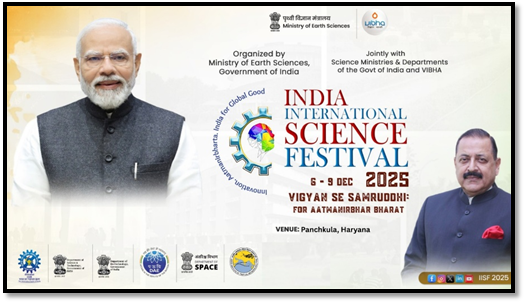
The 11th India International Science Festival (IISF) 2025 is scheduled from 06–09 December 2025 in Panchkula, Haryana under the theme “Vigyan Se Samruddhi: for Aatmanirbhar Bharat”. Launched in 2015 under the vision of Hon’ble PM Narendra Modi, IISF has emerged as one of India’s largest platforms promoting scientific temper, innovation, and public engagement in science. The festival brings together scientists, innovators, educators, students, policymakers, and industry leaders to showcase breakthroughs, exchange knowledge, and foster collaboration.
Analysis
The IISF 2025 emphasizes science-led national development with a focus on self-reliance (Aatmanirbhar Bharat). Its structure and agenda highlight the government’s commitment to bridging traditional knowledge with modern science and promoting inclusive participation.
- Scale and Participation:
- Expected 40,000+ participants including scientists, researchers, students, innovators, industry representatives, and policy-makers.
- Over 150 technical and thematic sessions in areas such as AI, Bio-Economy, Quantum Technology, Gene Editing, and Space Applications.
- Special sessions for women scientists, young entrepreneurs, and early-career researchers underscore the inclusive character of the festival.
- Thematic Focus:
IISF 2025 will prioritize five broad themes:- Science, Technology, and Ecology of North-West India & Himalayan Region
- Science for Society and Education
- Atmanirbhar Bharat through Science and Technology
- Biotechnology and Bio-economy
- Integration of Traditional Knowledge with Modern Science
- Institutional Collaboration:
- Coordinating agency: Indian Institute of Tropical Meteorology (IITM, Pune)
- Lead Ministry: Ministry of Earth Sciences (MoES)
- Partner Ministries and Agencies include DST, DBT, CSIR, Department of Space, Department of Atomic Energy, and Vijnana Bharati (VIBHA).
- Collaboration ensures knowledge exchange, technology demonstrations, and industry-academia linkages.
- Innovation and Outreach:
- Exhibitions, B2B meetings, competitions, and cultural programs bridge the gap between laboratories and society.
- Focused tracks on satellites, launch systems, climate science, and regional technology innovations enhance practical engagement.
- Previous editions have demonstrated Guinness World Records, large-scale student activities, and outreach to rural areas, indicating science popularization as a key objective.
- Strategic Implications:
- Reinforces India’s global leadership in science and technology.
- Strengthens innovation ecosystem, linking startups, research institutions, and traditional knowledge custodians.
- Promotes inclusive development through targeted participation of underrepresented groups.
- Serves as a platform to align scientific research with national development goals, particularly in AI, biotechnology, and space sectors.
Static Institutional Part
| Edition | Details |
|---|---|
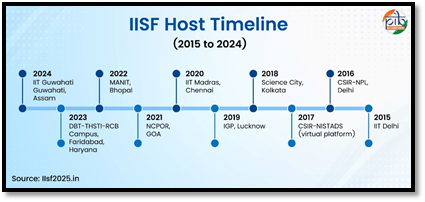
| 10th Edition (2024, IIT Guwahati, Assam) | Theme – “Transforming India into an S&T-driven Global Manufacturing Hub”, 35,000 visitors |
| 9th Edition (2024, Faridabad, Haryana) | Theme – “Science and Technology, Public Outreach in Amrit Kaal”, 1 lakh visitors |
| Previous Records | Guinness World Records in largest biology lessons, model rocket kits, and science activities for students |
About IITM
- Established: 17 November 1962 as Institute of Tropical Meteorology (ITM), Pune
- Autonomous Status: From 1 April 1971, renamed Indian Institute of Tropical Meteorology (IITM)
- Historical Evolution: Initially under Ministry of Tourism & Civil Aviation → moved to DST in 1985 → under MoES since 12 July 2006
- Purpose: To address fundamental atmospheric problems, understand monsoon mechanisms, weather systems, and climate processes in tropical regions, especially India
- Role in IISF: Serves as coordinating nodal agency for technical, thematic, and research participation
Updated: 05 December 2025; 01:25 PM | PIB Delhi