INDIA’S MISSION FOR AATMANIRBHARTA IN PULSES
INDIA’S MISSION FOR AATMANIRBHARTA IN PULSES
Introduction
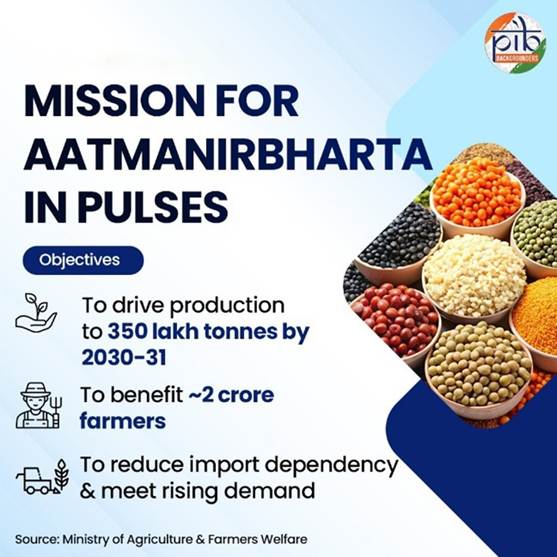
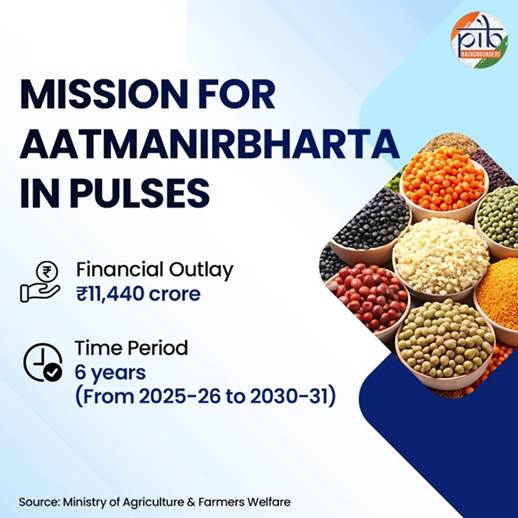
The Government of India has launched the Mission for Aatmanirbharta in Pulses (2025–26 to 2030–31) with a total budgetary allocation of ₹11,440 crore to strengthen India’s pulses sector, enhance nutritional security, reduce import dependence, and improve farmers’ income. The Mission was launched by Prime Minister Narendra Modi on 11 October 2025 at the Indian Agricultural Research Institute, New Delhi.The Mission seeks to scale up domestic pulses production to 350 lakh tonnes and expand cultivation area to 310 lakh hectares by 2030–31. It represents a major policy push towards achieving Aatmanirbhar Bharat in pulses and ensuring long-term food and nutritional security.
WHY PULSES ARE IMPORTANT FOR INDIA
Pulses hold strategic importance in India because of their role in:
- Nutritional Security
- Pulses contribute nearly 20–25% of total protein intake in Indian diets as per the National Institute of Nutrition.
- Per capita consumption remains below the recommended 85 grams/day, contributing to protein-energy malnutrition.
- Soil Health Improvement
- Pulses improve soil fertility through nitrogen fixation.
- They support sustainable and climate-resilient agriculture.
- Farmers’ Livelihoods
- Pulses cultivation supports millions of small and marginal farmers.
- Crop diversification towards pulses can improve farm income stability.
- Import Reduction
- India imported 47.38 lakh tonnes of pulses in 2023–24 despite being the world’s largest producer and consumer.
BACKGROUND OF INDIA’S PULSES SECTOR
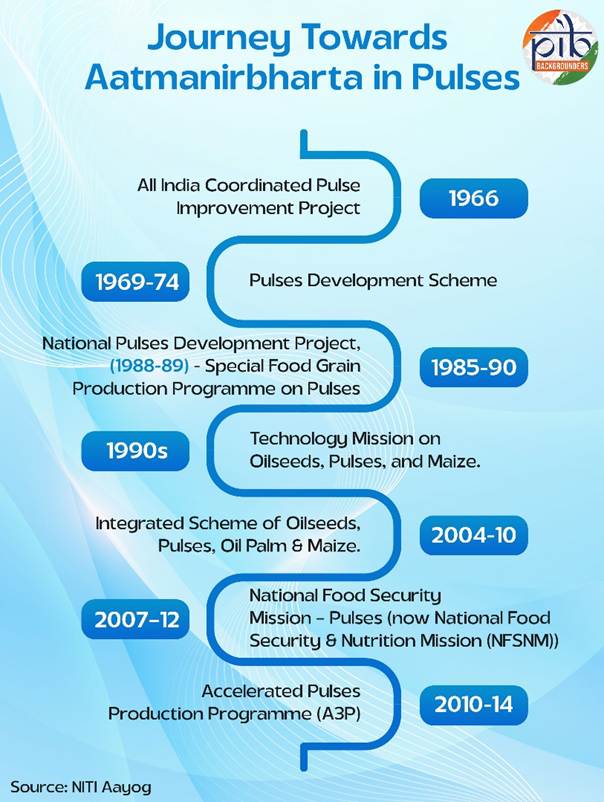
India has witnessed substantial growth in pulses production due to continuous policy interventions under the National Food Security and Nutrition Mission (NFSNM).
| Indicator | Data |
|---|---|
| Pulses Production (2013–14) | 192.6 lakh tonnes |
| Pulses Production (2024–25) | 252.38 lakh tonnes |
| Growth in Production | Over 31% |
| Pulses Imports (2023–24) | 47.38 lakh tonnes |
| Pulses Exports (2023–24) | 5.94 lakh tonnes |
Despite progress, domestic demand continues to outpace production, necessitating imports.Prime Minister Narendra Modi has set the target of making India fully self-reliant in pulses by December 2027, particularly in:
- Tur (Arhar)
- Urad
- Masoor
OBJECTIVES OF THE MISSION
The Mission for Aatmanirbharta in Pulses aims to:
- Achieve self-sufficiency in pulses
- Reduce import dependence
- Improve farmers’ income sustainably
- Promote climate-resilient agriculture
- Expand pulses cultivation by 35 lakh hectares
- Increase production to 350 lakh tonnes
- Improve productivity to 1,130 kg/hectare
KEY FEATURES OF THE MISSION
Expansion of Cultivation Area
The Mission plans to:
- Bring additional land under pulses cultivation
- Utilize rice fallows and suitable uncultivated lands
- Promote:
- Intercropping
- Crop diversification
- Cluster-based cultivation
Seed System Strengthening
A major focus is on high-quality seed distribution and traceability.Key provisions include:
| Provision | Target |
|---|---|
| Certified Seeds Distribution | 126 lakh quintals |
| Free Seed Kits | 88 lakh |
| Seed Production Planning | Rolling 5-year plans by states |
The Mission emphasizes:
- High-yielding varieties
- Pest-resistant seeds
- Climate-resilient pulses varieties
SATHI PORTAL
Seed Authentication, Traceability & Holistic Inventory (SATHI)
The Mission will use the SATHI portal (seedtrace.gov.in) for monitoring and traceability.
Functions of SATHI
- Seed production tracking
- Seed certification
- Inventory management
- Licensing
- Dealer-based seed sale monitoring
- End-to-end traceability of seeds
The portal was developed by:
- Ministry of Agriculture and Farmers’ Welfare
- National Informatics Centre (NIC)
PROCUREMENT SUPPORT UNDER PM-AASHA
The Government will ensure 100% procurement of:
- Tur (Arhar)
- Urad
- Masoor
This procurement assurance will continue for four years under the:
Pradhan Mantri Annadata Aay Sanrakshan Abhiyan (PM-AASHA)
Benefits
- Assured MSP procurement
- Reduction in price uncertainty
- Increased farmer confidence
- Encouragement for pulses cultivation
Procurement agencies:
- National Agricultural Cooperative Marketing Federation of India (NAFED)
- National Cooperative Consumers’ Federation (NCCF)
POST-HARVEST VALUE CHAIN DEVELOPMENT
The Mission also focuses on strengthening the post-harvest ecosystem.
Major Interventions
- Establishment of 1,000 processing and packaging units
- Subsidy support up to ₹25 lakh per unit
- Reduction in post-harvest losses
- Promotion of rural employment
- Enhancement of value addition
ROLE OF NITI AAYOG
NITI Aayog provided major recommendations based on consultations with 885 farmers across:
- Rajasthan
- Madhya Pradesh
- Gujarat
- Andhra Pradesh
- Karnataka
Major Recommendations
- Cluster-based pulses cultivation
- Expansion into rice fallows
- “One Block–One Seed Village” model
- Establishment of seed hubs
- Strengthening Farmer Producer Organizations (FPOs)
- Integration of pulses into:
- PDS
- Mid-Day Meal schemes
- Promotion of:
- Mechanization
- Efficient irrigation
- Bio-fertilizers
- Climate-resilient varieties
SIGNIFICANCE OF THE MISSION
Nutritional Security
The Mission can:
- Improve protein intake
- Address malnutrition
- Strengthen food security
Economic Significance
- Reduce import bill
- Conserve foreign exchange
- Improve farmers’ income
Agricultural Sustainability
- Promote diversified cropping systems
- Improve soil fertility
- Encourage climate-resilient farming
Rural Employment Generation
Processing units and value chain infrastructure can create employment opportunities in rural areas.
CHALLENGES
Despite ambitious targets, several challenges remain:
- Low productivity in rainfed regions
- Climate variability
- Pest attacks
- Market volatility
- Storage and processing gaps
- Dependence on imports for certain pulses
Effective coordination among:
- Central government
- State governments
- ICAR
- KVKs
- Procurement agencies
will be essential for success.
CONCLUSION
The Mission for Aatmanirbharta in Pulses marks a transformative initiative aimed at ensuring India’s nutritional, agricultural, and economic security. By combining assured procurement, scientific seed systems, value-chain development, and climate-resilient agriculture, the Mission seeks to create a sustainable and self-reliant pulses ecosystem.The initiative aligns with the broader vision of Viksit Bharat and Aatmanirbhar Bharat, while simultaneously empowering farmers, improving dietary nutrition, reducing import dependence, and strengthening rural livelihoods.
NECESSARY STATIC PART
National Food Security and Nutrition Mission (NFSNM)
| Aspect | Details |
|---|---|
| Objective | Enhance production of food crops including pulses |
| Focus Areas | Productivity enhancement, nutritional security |
| Sector Covered | Agriculture and food security |
PM-AASHA
| Aspect | Details |
|---|---|
| Full Form | Pradhan Mantri Annadata Aay Sanrakshan Abhiyan |
| Launched | September 2018 |
| Objective | Provide price assurance for pulses, oilseeds and copra |
| Components | PSS, PDPS, MIS |
Components of PM-AASHA
| Component | Full Form |
|---|---|
| PSS | Price Support Scheme |
| PDPS | Price Deficiency Payment Scheme |
| MIS | Market Intervention Scheme |
NAFED
| Aspect | Details |
|---|---|
| Full Form | National Agricultural Cooperative Marketing Federation of India |
| Function | Procurement and marketing support for agricultural commodities |
NCCF
| Aspect | Details |
|---|---|
| Full Form | National Cooperative Consumers’ Federation |
| Function | Consumer cooperative procurement and distribution |
ICAR
| Aspect | Details |
|---|---|
| Full Form | Indian Council of Agricultural Research |
| Role | Agricultural research and breeder seed production |
KVKs
| Aspect | Details |
|---|---|
| Full Form | Krishi Vigyan Kendras |
| Function | Agricultural extension and farmer training |
Updated - 11 October 2025 ; 06:42 PM | PIB | PIB News Source