India’s Rising Global Leadership in Spice Economy
IN NEWS: India’s Rising Global Leadership in Spice Economy
Introduction
India, often referred to as the ‘Land of Spices’, continues to dominate the global spice trade as the largest producer, consumer, and exporter. With cultivation of 60+ spice varieties out of 109 recognized globally, the sector contributes significantly to agricultural and horticultural exports. Recent data highlights strong growth in exports, increasing global demand, and a policy-driven push towards value-added and sustainable spice production.
ANALYSIS
Global Leadership & Export Performance
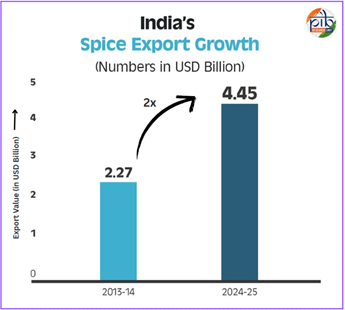
India has maintained its position as the world’s leading exporter of spices, with exports reaching USD 4.45 billion in FY 2024–25. Over the last decade (2013–14 to 2024–25), the sector has witnessed 88% growth in volume and 97% growth in value, reflecting strong global demand and competitiveness. The export basket includes 225+ spice products exported to over 200 countries, demonstrating diversification and global reach.The top export destinations, including China, USA, UAE, Bangladesh, Thailand, Malaysia, UK, Saudi Arabia, Indonesia, and Germany, account for over 60% of export earnings, indicating concentration in key global markets.
State-wise Export & Production Dynamics
At the domestic level, Gujarat leads exports with 23.53% share, followed by Kerala and Andhra Pradesh.In terms of production:
- Madhya Pradesh leads with 3.63 million tonnes
- Followed by Gujarat and Andhra Pradesh
- Rajasthan and Telangana also contribute significantly
This reflects a geographical specialization pattern, where certain states dominate either production or export value chains.
Major Exported Spices (Value Perspective)
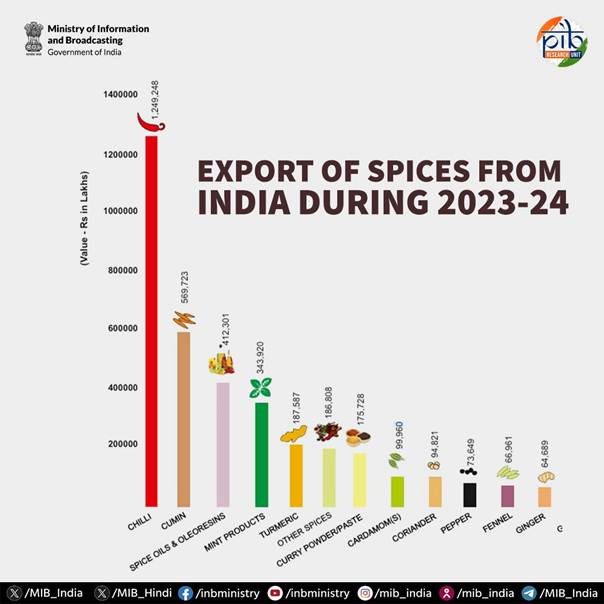
- Chilli – Highest export value (USD 1508.94 million)
- Cumin – Second largest
- Spice oils & oleoresins – High value-added segment
- Other contributors: mint products, turmeric, curry powders
This indicates a shift from raw exports → value-added processed spice products, enhancing export earnings.
Government Policy & Institutional Push
The growth of the spice economy is strongly supported by policy initiatives:
- SPICED Scheme (2025–26)
→ Focus on export development, value addition, and quality improvement
→ Outlay: ₹422.30 crore
→ Targets: FPOs, SMEs, SC/ST communities - Spices Parks Infrastructure
→ 8 crop-specific parks across India
→ Provide facilities like processing, grading, packaging, oil extraction
→ Promote cluster-based industrialisation and employment generation
These initiatives highlight a value-chain approach: production → processing → export competitiveness.
Strategic & Economic Implications
- Agri-export diversification: Reduces dependence on traditional commodities
- Rural income boost: Supports farmers through FPOs and value addition
- Global positioning: Strengthens India as a trusted supplier in health-conscious markets
- Post-COVID demand surge: Increased demand for spices with medicinal and immunity-boosting properties
STATIC PART
Spices Board of India
- Established: 1987
- Headquarters: Kochi, Kerala
- Function:
- Promotion and regulation of export of 52 spices
- Development of production, processing, and marketing
- Special focus on cardamom cultivation and export
- Vision: Sustain leadership in global spice trade
- Mission: Make India a global hub for clean, safe, value-added spices
Updated – 01 May 2025 ; 4:33 PM | PIB | News Source: Press Information Bureau