PHYSICS
PHYSICS
Magnetic Field of a Magnet
The magnetic field strength is maximum at the poles of a magnet because the magnetic field lines are most densely packed in these regions. The poles are located near the ends of the magnet and represent the points where the magnetic force is concentrated and acts most strongly. Magnetic field lines emerge from the north pole and enter the south pole, forming a closed loop around the magnet. Since the density of magnetic field lines corresponds directly to the strength of the magnetic field, the highest field strength is observed at the poles. These regions interact most strongly with other magnets and magnetic materials, making them important in devices such as magnetic compasses, where field strength and direction are critical.
Other Regions of the Magnet
| Region | Magnetic Field Strength |
|---|---|
| At the Poles | Maximum |
| Equidistant from the Poles | Lower because field lines are more spread out |
| At the Centre of the Magnet | Weaker due to more uniform distribution of field lines |
| At Infinity | Virtually zero because the field weakens with distance |
At points equidistant from the poles, the magnetic field is weaker because the field lines are not concentrated. At the centre of the magnet, the field is comparatively weaker as the field lines are more uniformly distributed and magnetic effects from opposite poles tend to balance. At infinity, the magnetic field approaches zero because the magnetic influence decreases significantly with increasing distance.
Gravitational Force Between Two Objects
The gravitational force between two objects is determined using Newton's Law of Universal Gravitation.
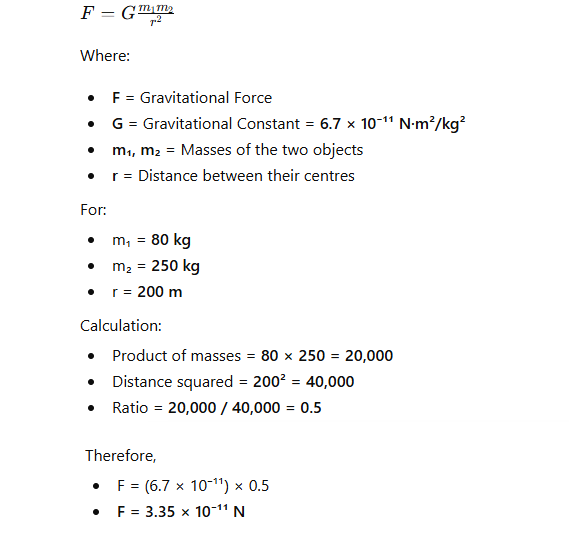
Key Concepts
- Gravitational force is a universal force of attraction acting between all objects possessing mass.
- The force is directly proportional to the product of masses.
- The force is inversely proportional to the square of the distance between the objects.
- Though extremely weak for small masses, gravitational force becomes significant for planets, stars, and other massive celestial bodies.
Liquids and Fluidity
Liquids possess loosely packed molecules. Their particles are held together by intermolecular forces, but these forces are weak enough to allow molecules to move freely and slide past one another. This gives liquids the property of fluidity, enabling them to flow and take the shape of the container they occupy.Because intermolecular forces are only partially overcome, liquid molecules retain sufficient kinetic energy to move continuously while remaining relatively close together. This distinguishes liquids from solids, whose particles remain fixed, and from gases, whose particles move almost independently.The sliding motion of molecules is also responsible for viscosity, which determines how easily a liquid flows. Common examples include water, oil, and milk.
Important Clarifications
- Liquids do possess intermolecular forces.
- Liquids do possess kinetic energy.
- Molecular movement in liquids is not completely unrestricted because intermolecular forces still influence particle motion.
Solids and Incompressibility
Solids are characterized by strong intermolecular forces that hold particles tightly together in fixed positions. Due to this close packing, there is very little empty space between particles.Particles in solids can only vibrate about their fixed positions and cannot move freely. Since almost no space exists between particles, solids cannot be compressed easily.The strong intermolecular forces also give solids their:
- Fixed shape
- Fixed volume
- Rigidity
- High resistance to compression
Examples include metals, crystals, and diamonds.
Reverberation
Reverberation is the phenomenon of multiple echoes produced due to repeated reflections of sound waves.
Occurrence
Sound waves reflect repeatedly from:
- Walls
- Ceilings
- Floors
Commonly experienced in:
- Auditoriums
- Churches
- Large halls
Effects
Useful Effects
- Enhances sound quality.
- Makes sound fuller and richer.
Harmful Effects
- Excessive reverberation makes sound unclear.
- Causes muddled speech and poor audibility.
Control
Architects and engineers use suitable construction materials to control reverberation and obtain desired acoustical properties.
Reverberation Time
Measurement of reverberation time is important in acoustical engineering to ensure proper sound quality.
Presbyopia
Presbyopia is an age-related vision defect usually occurring after 40 years of age.
Cause
- Weakening of ciliary muscles.
- Reduced flexibility in changing the shape of the eye lens.
Effect
- Difficulty focusing on nearby objects.
- Problems in reading and other close-up activities.
Correction
- Reading glasses.
- Bifocal lenses.
Important Point
Presbyopia is a natural aging process and is not caused by injury or disease.
Other Vision Defects
Astigmatism
- Cornea or lens has irregular shape.
- Causes blurred vision at all distances.
- Corrected by glasses or contact lenses.
- Can occur at any age.
Hypermetropia (Farsightedness)
- Distant objects appear clearer than nearby objects.
- Eye is too short or cornea has insufficient curvature.
- Light focuses behind the retina.
- Corrected using suitable lenses.
Myopia (Nearsightedness)
- Nearby objects are clear.
- Distant objects appear blurred.
- Eye is too long or cornea has excessive curvature.
- Light focuses in front of the retina.
- Corrected using suitable lenses.
Thermal Expansion of Matter
Among solids, liquids, and gases, gases show the highest expansion when temperature increases.
Reasons
- Molecules are very far apart.
- Temperature rise increases kinetic energy significantly.
- Molecules move rapidly and spread apart.
- Gases occupy the entire available volume.
Additional Feature
- Highly compressible.
- Expansion follows the Ideal Gas Law.
Inertia
Inertia is the property of a body that resists changes in its state of motion.
Characteristics
- Directly proportional to mass.
- Greater mass → Greater inertia.
- More force is required to change motion of a heavier body.
Newton's First Law
An object remains at rest or in uniform motion unless acted upon by an external force.
Example
A heavy truck possesses more inertia than a small car.
Wind and Evaporation
Wind increases the rate of evaporation from wet clothes.
Mechanism
- Removes moist air surrounding clothes.
- Replaces it with drier air.
- Reduces local humidity around clothes.
- Water molecules escape more easily into air.
Result
- Faster evaporation.
- Quicker drying of clothes.
Noise Produced During Jet Plane Take-off
Jet aircraft generate extremely high sound levels.
Characteristics
- Noise may exceed 140 decibels.
- Can cause immediate hearing damage without protection.
Sources of Noise
- Engine noise.
- Aerodynamic noise due to high-speed airflow.
Control Measures
Airports implement noise-abatement procedures to reduce impacts on nearby communities.
Ammeter
An ammeter measures electric current flowing through a circuit.
Connection
The ammeter must be connected in series with the component.
Reason
- Same current flows through both the ammeter and component.
- Ensures accurate current measurement.
Why Not Parallel?
- Ammeter has very low resistance.
- Parallel connection may cause a short circuit.
- Can damage both circuit and instrument.
Respiration
Respiration is the process through which organisms exchange gases with their surroundings.
Cellular Respiration
- Occurs in mitochondria.
- Oxygen is used to convert glucose into ATP.
- ATP serves as the energy currency of cells.
By-product
- Carbon dioxide is produced and expelled.
Respiratory System
Includes:
- Nose
- Trachea
- Lungs
- Diaphragm
Importance
- Energy production.
- Metabolic activities.
- Maintenance of homeostasis.
Sound Pitch and Frequency
The pitch of sound depends directly on its frequency.
Relationship
| Frequency | Pitch |
|---|---|
| High | High |
| Low | Low |
Examples
Low-frequency sounds resemble sounds produced by:
- Bass guitar
- Tuba
Human Hearing Range
20 Hz to 20,000 Hz
Applications
Low-frequency sounds are used in:
- Subwoofers
- Bass enhancement systems
2. Power of a Concave Lens
Question
A concave lens has a focal length of −2 cm. Find its power.
Formula
P = 1/f
Given
f = −2 cm = −0.02 m
Calculation
P = 1 / (−0.02)= −50 D
Answer
Power = −50 Dioptre
3. Image Distance in a Convex Lens
Question
An object is placed 15 cm in front of a convex lens of focal length 25 cm. Find the image distance.
Formula
1/f = 1/v − 1/u
Given
- f = +25 cm
- u = −15 cm
Calculation
1/25 = 1/v − (−1/15)1/25 = 1/v + 1/151/v = 1/25 − 1/151/v = (3 − 5)/751/v = −2/75v = −37.5 cm
Answer
Image Distance = −37.5 cmThe image is virtual and formed on the same side as the object.