PROJECT CHEETAH AND THE REVIVAL OF CHEETAHS IN INDIA
IN NEWS: PROJECT CHEETAH AND THE REVIVAL OF CHEETAHS IN INDIA
Introduction
Project Cheetah represents one of the most ambitious wildlife restoration programmes in the world and marks the world’s first inter-continental translocation of a large carnivore. The initiative aims to restore the extinct cheetah population in India and revive degraded grassland and savanna ecosystems.Launched officially on 17 September 2022 at Kuno National Park, Madhya Pradesh, the project reflects India’s commitment toward:
- Biodiversity restoration
- Ecosystem recovery
- Scientific conservation
- Community-based ecological stewardship
As of December 2025, India hosts:
- 30 cheetahs
- 12 adults
- 9 sub-adults
- 9 cubs
including:
- 11 founder cheetahs
- 19 India-born cheetahs
The initiative is being implemented under the aegis of the:
- Ministry of Environment, Forest and Climate Change (MoEFCC)
- National Tiger Conservation Authority (NTCA)
HISTORICAL CONTEXT: EXTINCTION OF CHEETAHS IN INDIA
The Asiatic cheetah once occupied vast open landscapes across India including:
- Punjab
- Rajasthan
- Gujarat
- Bengal
- Tamil Nadu
Habitat Types
- Dry grasslands
- Scrub forests
- Savannas
- Semi-arid ecosystems
The final confirmed sighting of wild cheetahs in India occurred in:
- 1947
- Koriya district (present-day Chhattisgarh)
The species was officially declared extinct in India in:
- 1952
Causes of Extinction
- Excessive hunting
- Poaching
- Habitat destruction
- Decline in prey species
- Agricultural expansion
- Low reproductive rate
- Narrow genetic diversity
The extinction created a major ecological gap in India’s grassland ecosystems.
PROJECT CHEETAH: OBJECTIVES
Project Cheetah seeks to establish a:
- Self-sustaining metapopulation
- Of around 60–70 cheetahs
- Across approximately 17,000 km²
- By 2032
Major Objectives
- Restore grassland and savanna ecosystems
- Reintroduce a top predator
- Improve biodiversity conservation
- Enhance ecological balance
- Support climate resilience through ecosystem restoration
The cheetah has been designated as:
- A flagship species
- An umbrella species
to support broader grassland biodiversity conservation.
KUNO NATIONAL PARK AS REINTRODUCTION SITE
Why Kuno Was Selected
Kuno National Park was identified as the most suitable site because of:
- Adequate habitat
- Sufficient prey base
- Large inviolate landscape
- Minimal human disturbance
Important Features
| Aspect | Details |
|---|---|
| Core Area | 748 km² |
| Expanded Landscape | Around 3,200 km² |
| Villages Relocated | 24 villages |
| Families Relocated | 1,545 families |
| Grassland Created | Around 6,258 hectares |
The relocation programme enabled the creation of a viable landscape for large carnivores.
TRANSLOCATION AND INTERNATIONAL COOPERATION
Project Cheetah became the world’s first:
- Inter-continental wild-to-wild cheetah translocation
Key Milestones
| Date | Event |
|---|---|
| 17 September 2022 | 8 cheetahs brought from Namibia |
| February 2023 | 12 cheetahs brought from South Africa |
| November 2025 | Botswana gifted 8 cheetahs |
The translocation involved:
- Indian Air Force C-17 Globemaster aircraft
- Scientific quarantine protocols
- Radio-collaring
- Post-release monitoring
International Agreements
India signed:
- MoU with Namibia (July 2022)
- MoU with South Africa (January 2023)
These agreements include:
- Technical cooperation
- Training
- Conservation exchange
- Scientific management
ECOLOGICAL SUCCESS AND BREEDING ACHIEVEMENTS
One of the strongest indicators of ecological adaptation is successful breeding.
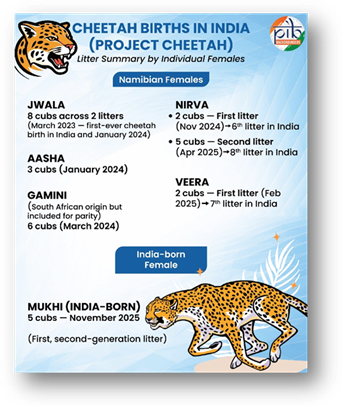
Important Reproductive Milestones
| Female Cheetah | Cubs |
|---|---|
| Jwala | 8 cubs |
| Aasha | 3 cubs |
| Gamini | 6 cubs |
| Nirva | 7 cubs across two litters |
| Veera | 2 cubs |
| Mukhi (India-born) | 5 cubs |
Mukhi: A Historic Milestone
Mukhi became:
- The first India-born cheetah cub
- Later gave birth to five cubs
This marks:
- Second-generation breeding success
- Long-term ecological viability
The early breeding success indicates:
- Habitat suitability
- Adequate prey availability
- Low ecological stress
METAPOPULATION STRATEGY
The project adopts a:
- Metapopulation approach
Next Expansion Site
- Gandhi Sagar Wildlife Sanctuary
Features
| Aspect | Details |
|---|---|
| Sanctuary Area | 368 km² |
| Potential Habitat | Around 2,500 km² |
| Distance from Kuno | Around 300 km |
The strategy seeks to establish:
- Landscape connectivity
- Genetic diversity
- Long-term species survival
COMMUNITY PARTICIPATION AND LIVELIHOODS
Project Cheetah emphasizes:
- Inclusive conservation
- Community partnership
Cheetah Mitras
- More than 450 Cheetah Mitras
- Across around 80 villages
Employment Generation
| Category | Approximate Employment |
|---|---|
| Cheetah trackers | 80 locals |
| Suraksha Sramik | Around 200 |
| Safari guides | Local youth trained |
Additional Benefits
- Eco-tourism revenue sharing
- Infrastructure development
- Awareness campaigns
- Ecological education
This demonstrates integration of:
- Conservation
- Livelihood generation
- Local participation
INTERNATIONAL BIG CAT ALLIANCE (IBCA)
India also established:
- International Big Cat Alliance
Important Features
| Aspect | Details |
|---|---|
| Launched | 9 April 2023 |
| Budgetary Support | ₹150 crore till 2027–28 |
| Objective | Global cooperation for big cat conservation |
The Alliance focuses on:
- Research cooperation
- Technology sharing
- Capacity building
- Transnational conservation
ECOLOGICAL AND POLICY SIGNIFICANCE
Project Cheetah reflects a broader shift toward:
- Rewilding
- Ecosystem restoration
- Climate-resilient conservation
The project aligns with:
- Convention on Biological Diversity (CBD)
- UN Sustainable Development Goal 15
- Mission LiFE principles
It also demonstrates India’s growing role in:
- Global conservation diplomacy
- Science-driven ecological restoration
- International wildlife cooperation
CHALLENGES
Despite progress, the project faces several concerns:
Key Challenges
- Habitat connectivity
- Human-wildlife interaction
- Disease management
- Long-term prey sustainability
- Genetic diversity maintenance
- Ecological adaptation
The success of the programme depends upon:
- Scientific monitoring
- Long-term habitat management
- Community support
- Landscape-level conservation
NECESSARY STATIC PART
Project Cheetah
| Aspect | Details |
|---|---|
| Official Launch | 17 September 2022 |
| Implementing Agencies | MoEFCC and NTCA |
| First Site | Kuno National Park, Madhya Pradesh |
| Objective | Reintroduction of cheetahs and ecosystem restoration |
National Tiger Conservation Authority (NTCA)
| Aspect | Details |
|---|---|
| Established | 2005 |
| Ministry | Ministry of Environment, Forest and Climate Change |
| Function | Tiger conservation and wildlife protection |
Kuno National Park
| Aspect | Details |
|---|---|
| Location | Madhya Pradesh |
| Importance | First cheetah reintroduction site in India |
International Big Cat Alliance (IBCA)
| Aspect | Details |
|---|---|
| Launched | 2023 |
| Headquarters | India |
| Objective | Conservation of seven big cat species |
Asiatic Cheetah
| Aspect | Details |
|---|---|
| Scientific Name | Acinonyx jubatus venaticus |
| Declared Extinct in India | 1952 |
Updated - 12 December 2025 ; 03:04 PM | PIB Explainer