Serial Nomination of Buddhist Triangle Sites of Odisha
Serial Nomination of Buddhist Triangle Sites of Odisha
Introduction
The Buddhist Triangle Sites of Odisha — Lalitagiri, Udayagiri and Ratnagiri — have been submitted to the UNESCO Tentative List as a Cultural World Heritage nomination. Submitted on 22 December 2025, this serial nomination represents the evolution of Buddhist philosophy, art and monastic traditions in eastern India from Theravada/Hinayana to Mahayana and Vajrayana Buddhism.These sites are located in the Assia hill range of Odisha, within the cultural landscape shaped by the Brahmani, Birupa and Kelua river systems. Together, they form an interconnected Buddhist landscape that cannot be viewed in isolation.
Buddhist Triangle of Odisha: Core Idea
The three Buddhist complexes show a long religious and cultural continuity from the 2nd–3rd century BCE to the 13th century CE. They were not only centres of worship and learning but also spaces of artistic, architectural and technological innovation.
| Site | District | Key Significance |
|---|---|---|
| Lalitagiri | Cuttack | Early Buddhist centre with Theravada/Hinayana phase, relic caskets and monastic remains |
| Udayagiri | Jajpur | Major centre of Mahayana and later Vajrayana traditions |
| Ratnagiri | Jajpur | Important Vajrayana epicentre, especially under Bhaumakara patronage |
Lalitagiri: Early Buddhist Centre
Lalitagiri, located on the Nandapahad hillock in the Birupa river valley, shows cultural continuity from the 2nd–3rd century BCE to the 13th century CE.Excavations by Utkal University, Bhubaneswar (1977) and the Archaeological Survey of India (1985–1991) revealed major Buddhist remains, including an apsidal Chaityagriha, four monasteries and a massive stupa of the Theravada/Hinayana phase.The most important discovery was the relic caskets made of khondalite stone, containing steatite, silver and gold caskets. The site also yielded images of Buddha, Vajrapani, Manjusri, Aparajita, Tara, Jambhala and Hariti, showing the gradual transition from early Buddhist traditions to Mahayana and Vajrayana phases.
Udayagiri: Monastic and Architectural Development
Udayagiri, also known as “Sunrise Hill”, is located in the Assia hill range on the right bank of the Birupa River. It was first recorded in 1870 and later excavated by the Archaeological Survey of India.The site revealed two major monastic complexes:
| Complex | Key Features |
|---|---|
| Madhavapura Mahavihara | Brick-built monastic complex, Mahastupa, Dhyani Buddha images |
| Simhaprastha Mahavihara | Double-storied monastery, pradakshinapatha, vaulted windows, upper shrine chamber |
Udayagiri is significant for showing the structural evolution of Chaityagriha architecture, where the plan transformed from circular to apsidal to rectangular. The site also produced sculptures of Tara, Manjusri, Bhrikuti, Hariti, Chunda, Avalokiteswara, Maitreya, Aparajita, Vairochana and Vasudhara.
Ratnagiri: Vajrayana Epicentre
Ratnagiri, meaning “hill of jewels”, is situated on the left bank of the Kelua River, a distributary of the Brahmani River. It flourished between the 4th and 12th centuries CE and attained prominence under the Bhaumakara dynasty during the 8th–10th century CE.Excavations by the Archaeological Survey of India (1958–1961, 2024–2025) exposed a major Buddhist establishment consisting of a Mahastupa, Chaityagriha, monastic complexes, shrines, votive stupas, Buddha heads, sculptures and architectural fragments.Ratnagiri is especially important for Vajrayana Buddhism. Images of Vajrapani, Manjusri, Aparajita, Astamahabhaya Tara, Chunda, Vajra-Gandha Tara, Jambhala and Hariti were recovered from the site.A copperplate inscription records that Queen Karpurashri, consort of Karnadeva Kesari, resided here, making it an important testimony to female patronage.
Art, Architecture and Syncretism
The Buddhist Triangle reflects the transformation of Buddhist art from Hinayana to Mahayana and Vajrayana. The sites show the use of Vajra motifs, evolution of stupa architecture, and the incorporation of Brahmanical iconographic features into Buddhist divinities.The Bhaumakara period was especially important because Buddhist and Brahmanical elements strongly influenced each other. Ratnagiri’s monolithic stupas, designed in forms such as Kalingan order and Panchayatan style, show a rare fusion of Buddhist and Brahmanical architectural traditions.The sculptures also reflect the role of local artisans, as the facial features of many images resemble local inhabitants. The use of khondalite stone from the Assia hill range highlights local material and craftsmanship.
Historical and Cultural Significance
The sites collectively show Odisha’s role in wider Buddhist networks. A notable trans-regional link is recorded in 795 CE, when Bhauma king Sivakaradeva sent a Buddhist manuscript, Gaṇḍavyuha, to Chinese Emperor Dezong through the monk Prajna.The Bhaumakara period also reflects the importance of women’s leadership, with six ruling queens in succession during the 9th–10th century CE who actively patronised monastic establishments.
UNESCO Criteria and Justification
| Criterion | Justification |
|---|---|
| Criterion (ii) | Shows significant interchange of values through the evolution of Buddhist art and architecture from Hinayana to Mahayana and Vajrayana, along with syncretism with Brahmanical iconography |
| Criterion (iv) | Represents an outstanding example of Buddhist monastic architecture, stupa traditions, sculptural art and religious syncretism in eastern India |
Authenticity and Integrity
The authenticity of the Buddhist Triangle lies in its architectural remains, sculptural traditions, original materials and landscape setting. The sites preserve stupas, monasteries, Chaityagrihas, sculptures and inscriptions in their cultural landscape.The integrity of the serial nomination is strengthened by the presence of essential elements such as stupas of different typologies, monasteries, structural remains and sculptural programmes spread across several centuries. All three sites are protected under the Ancient Monuments and Archaeological Sites and Remains (AMASR) Act and managed by the Archaeological Survey of India.
Comparison with Similar Properties
The Buddhist Triangle has been compared with major Buddhist World Heritage properties in India and abroad.
| Site | Comparison |
|---|---|
| Ajanta Caves | Ajanta is known for paintings and Mahayana iconography; Odisha sites show longer continuity from 3rd century BCE to 13th century CE |
| Nalanda Mahavihara | Nalanda represents organized transmission of knowledge; Odisha sites show long continuity of Buddhist monastic and philosophical traditions |
| Mahabodhi Temple Complex | Mahabodhi marks Buddha’s Enlightenment; Odisha sites reflect long-term development of Buddhist traditions |
| Bagan, Myanmar | Bagan reflects Buddhist sacred landscape; Odisha sites represent monastic and artistic continuity in eastern India |
| Takht-i-Bahi, Pakistan | Takht-i-Bahi represents Gandhara Buddhist monastic tradition; Odisha sites represent eastern Indian Buddhist evolution |
Analytical Significance
The Serial Nomination of the Buddhist Triangle Sites of Odisha is significant because it places Odisha within the wider history of Buddhist philosophy, monastic learning, art, architecture and trans-regional Buddhist networks. The three sites together represent the transformation of Buddhism across more than a millennium and show how local geography, artisanship, dynastic patronage and religious syncretism shaped eastern India’s Buddhist heritage.For examination purposes, these sites are important under Ancient Indian History, Buddhism, UNESCO Tentative List, Odisha Heritage, Buddhist Architecture, Vajrayana Buddhism and Cultural Landscapes.
NECESSARY STATIC PART
| Aspect | Details |
|---|---|
| Site Name | Serial Nomination of Buddhist Triangle Sites of Odisha |
| Country | India |
| Date of Submission | 22 December 2025 |
| UNESCO Reference | Ref. 6926 |
| Category | Cultural |
| Criteria Proposed | (ii), (iv) |
| Submitted by | Permanent Delegation of India to UNESCO |
| State/Region | Odisha |
| Sites Included | Lalitagiri, Udayagiri, Ratnagiri |
| Lalitagiri Location | Cuttack, Odisha |
| Udayagiri Location | Jajpur, Odisha |
| Ratnagiri Location | Jajpur, Odisha |
| Major River Systems | Brahmani, Birupa, Kelua |
| Associated Hill Range | Assia hill range |
| Major Buddhist Phases | Theravada/Hinayana, Mahayana, Vajrayana |
| Important Dynasty Mentioned | Bhaumakara dynasty |
| Institutions Mentioned | UNESCO World Heritage Centre, Permanent Delegation of India to UNESCO, Archaeological Survey of India, Utkal University |
| Legal Protection Mentioned | Ancient Monuments and Archaeological Sites and Remains Act |
| Management | Archaeological Survey of India |
STATIC PART
BIRUPA RIVER – POINTWISE NOTES
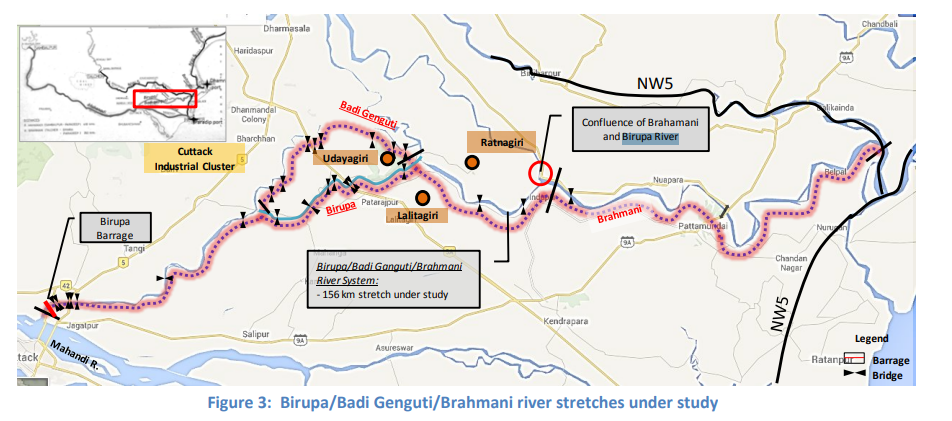
- Birupa River is an important distributary of the Mahanadi River in Odisha.
- Originates near Cuttack and flows downstream across coastal plains.
- Joins Brahmani River near Indupur/Krushnanagar (Kendrapada district) → drains into Bay of Bengal (Dhamra).
- Forms part of Mahanadi–Brahmani delta system; non-tidal river.
- Length studied: Birupa (77 km); part of 152 km system (with Badi Genguti & Brahmani).
- Badi Genguti tributary: branches at Samsarpur and rejoins at Kharagpur (anabranching pattern).
- Hydrology: Width 25–130 m, depth 0.7–5.3 m, HFL ~76.18 m; sand islands & deposits common.
- Infrastructure: Barrage (without locks); cross structures—Birupa (16), Badi Genguti (9), Brahmani (2); NH-5 & रेलवे पुल.
- Economic role: Paddy cultivation dominant, fertile banks; Chaudwar industrial belt depends on barrage water; low navigability.
- Cultural significance: Pancha Pandava Temple (9th century, Somavamsi); Buddhist sites—Lalitgiri, Ratnagiri, Udayagiri (Puspagiri tradition).
Updated – 23 Dec 2025 News Source: UNESCO World Heritage Centre