Textile sector strengthened under Union Budget 2026–27
Textile sector strengthened under Union Budget 2026–27
Introduction
The Union Budget 2026–27 places the textile sector at the centre of India’s growth strategy, recognising its role in employment generation, exports, rural livelihoods, and sustainable manufacturing. With a comprehensive policy framework, the government aims to enhance scale, competitiveness, and global integration of the textile value chain .
ANALYSIS
The policy direction for the textile sector reflects a holistic value-chain approach—from fibre to fashion, focusing on modernisation, diversification, and sustainability.
India’s textile industry holds strong structural advantages, being the largest cultivator of cotton, largest producer of jute, and a major global hub for man-made fibres (MMF) and technical textiles. The sector contributes around 2% to GDP, 11% to manufacturing GVA, and 8.63% to exports, while providing employment to over 45 million people, making it the second-largest employer after agriculture.
The Budget introduces an Integrated Programme for the Textile Sector, comprising five key components. The National Fibre Scheme aims to reduce dependence on cotton by promoting MMF, wool, silk, and advanced fibres, thereby enhancing diversification and technological capability. The Textile Expansion and Employment Scheme focuses on cluster modernisation, machinery upgradation, and quality compliance, which are essential for scaling production and improving competitiveness.
Support to traditional sectors is reinforced through the National Handloom and Handicraft Programme, ensuring income generation, heritage preservation, and market linkage for artisans. Simultaneously, the Tex-Eco Initiative promotes environmentally sustainable textile manufacturing, aligning with global standards and green market access.
Skill development is addressed through Samarth 2.0, which aims to create industry-ready manpower through collaboration with industry and academia, thereby bridging the skill gap across the value chain.
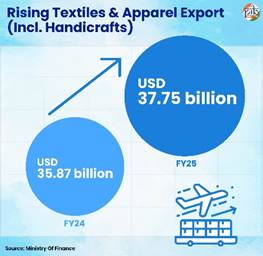
A major structural reform is the push for Mega Textile Parks (PM MITRA Scheme), designed to provide integrated infrastructure, economies of scale, and investment attraction. These parks are expected to boost technical textiles, which have applications in defence, healthcare, infrastructure, and industry, thus diversifying India’s textile exports.Export competitiveness is further enhanced by extending export obligation periods and leveraging trade agreements such as India-EU FTA, which offers duty reductions and improved market access. The sector has already shown resilience, with exports reaching USD 37.75 billion in FY25, despite global trade slowdown.
Liquidity support for MSMEs through TReDS integration, CGTMSE guarantees, and SME Growth Fund addresses credit constraints, while initiatives like ONDC and digital platforms strengthen supply chain integration.
Sustainability and circular economy practices are being promoted through initiatives such as upcycled product procurement, natural dyes, and eco-friendly production, aligning India’s textile sector with global ESG standards.
Overall, the policy framework indicates a transition towards a high-value, technology-driven, export-oriented textile ecosystem, supported by infrastructure, skilling, and global trade integration.
Implications
- Enhances global competitiveness and export potential of textile sector
- Promotes employment generation, especially in rural and labour-intensive segments
- Supports diversification into MMF and technical textiles
- Strengthens MSME participation and financial inclusion
- Aligns industry with sustainability and circular economy goals
Static Part
Institution: Ministry of Textiles
- Function: Policy formulation, promotion, and development of textile sector
- Coordinates with states, industry, and stakeholders for sectoral growth
Key Schemes / Initiatives
- PM MITRA Scheme: Mega integrated textile parks (₹4445 crore outlay)
- PLI Scheme for Textiles: Promotes MMF apparel and technical textiles
- Samarth 2.0: Skill development programme
- National Fibre Scheme: Promotes fibre diversification
- TReDS Platform: Financing MSME receivables
- CGTMSE: Credit guarantee support
Reports / Data Mentioned
- Textile exports: USD 37.75 billion (FY25)
- Employment: 45 million+ people
- Contribution: 2% GDP, 11% manufacturing GVA, 8.63% exports
Updated - 04 February 2026; 10:28 AM | PIB