Varkala Cliff – UNESCO Tentative List (Natural Heritage of Varkala)
Varkala Cliff – UNESCO Tentative List (Natural Heritage of Varkala)
Introduction
The inclusion of Varkala Cliff (Kerala) in UNESCO’s Tentative List highlights a rare coastal geomorphological feature along India’s western coast. Unlike the generally low-lying and linear west coast, Varkala presents a dramatic cliff system exposing Neogene sedimentary formations (Warkalli Formation), offering crucial insights into India’s geological evolution, coastal processes, and remnants of Gondwana breakup.
Geological & Geomorphological Significance
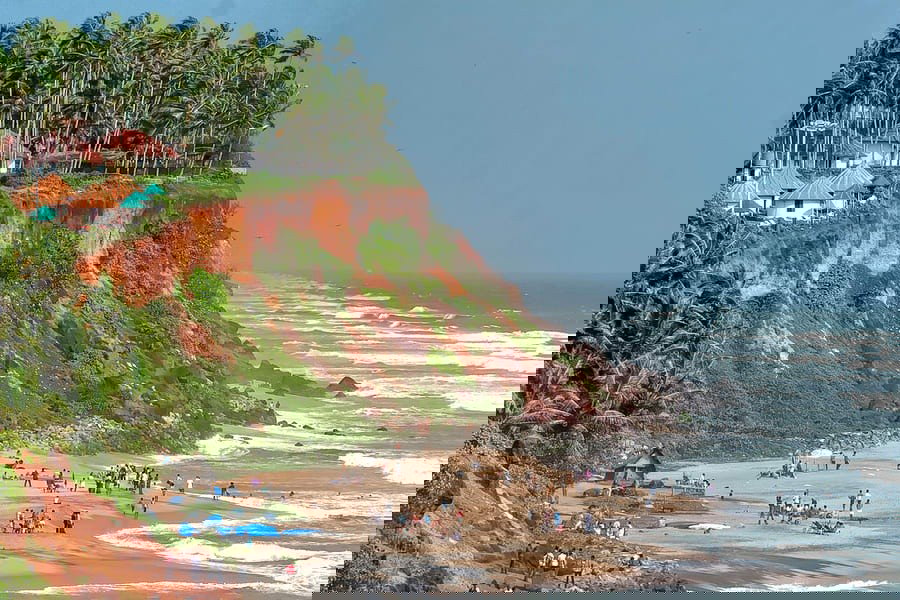
Varkala Cliff extends for approximately 6–7.5 km along the Arabian Sea, rising up to 40 metres, making it the only cliff formation of its kind on India’s western coastline. The cliff exposes Mio-Pliocene sedimentary sequences, including:
- Carbonaceous clay with lignite lenses
- Variegated sandstones and clays
- Marcasite and jarosite minerals
- Lateritic capping due to tropical weathering
These formations rest directly on Precambrian crystalline rocks (Khondalite), indicating a significant stratigraphic discontinuity and providing a clear geological timeline.The presence of jarosite (a Martian analogue mineral) makes the site scientifically significant for planetary geology studies, especially in understanding Earth–Mars environmental parallels.
Dynamic Coastal Processes & Evolution
The cliff represents a dynamic coastal geomorphic system, shaped by:
- Marine erosion and wave action
- Tectonic uplift along the West Coast Fault
- Marine regression and sediment deposition
- Lateritization under tropical climatic conditions
The area also shows evidence of:
- Last phase of Gondwana breakup
- Detachment of the Mascarene Plateau
- Formation of heavy mineral placers (ilmenite, zircon, monazite, garnet)
Thus, Varkala acts as a natural archive of Neogene geohistory, recording interactions between tectonics, climate, and coastal processes.
Aesthetic and Cultural Importance (Criterion vii)
Varkala Cliff is not only geologically significant but also a major aesthetic landscape, characterized by:
- Panoramic views of the Arabian Sea
- Golden sandy beaches below steep escarpments
- Natural springs emerging from cliffs
- Sunrise and sunset coastal vistas
The integration of natural beauty with cultural and spiritual elements enhances its tourism and heritage value, making it a unique geo-cultural landscape.
Scientific Value (Criterion viii)
The site holds exceptional scientific importance due to:
- Type locality of Warkalli Formation (Neogene period)
- Presence of microfossils, palynoflora, and ichnofossils
- Potential for fossil DNA studies
- Evidence of diverse paleo-environments (marine, freshwater, coastal)
The cliff provides insights into:
- Sedimentary processes
- Paleoclimate reconstruction
- Coastal evolution in monsoon-dominated regions
Comparative Global Significance
Compared to other global sites:
- Joggins Fossil Cliffs (Canada) → Paleozoic coal forest record
- White Cliffs of Dover (UK) → Chalk cliffs with marine erosion
- Great Ocean Road (Australia) → Limestone coastal erosion
Varkala stands out for:
- Tropical coastal sedimentary exposure
- Recent geological timeline (Neogene–Quaternary)
- Multi-process geomorphic evolution (marine + fluvial + aeolian)
Conservation Concerns & Management
Despite protection under:
- Geological Survey of India (National Geological Monument)
- Coastal Regulation Zone (CRZ)
The site faces threats from:
- Tourism pressure
- Unregulated construction (resorts)
- Coastal erosion acceleration
This necessitates:
- Sustainable geo-tourism planning
- Strict coastal regulation enforcement
- Awareness and conservation initiatives
NECESSARY STATIC PART
Institution Involved: Geological Survey of India (GSI)
- Role: Declares and manages National Geological Monuments
- Function: Geological mapping, resource assessment, conservation of geo-heritage sites
- Relevance: Varkala Cliff is designated as a National Geological Monument
International Framework
- UNESCO World Heritage Convention
- Submission by: Permanent Delegation of India to UNESCO
- Category: Natural
- Criteria: (vii) Aesthetic value, (viii) Geological significance
Conclusion
Varkala Cliff represents a rare convergence of geological history, coastal dynamics, and aesthetic beauty. Its inclusion in the UNESCO Tentative List underscores its importance as a global geo-heritage site, offering valuable insights into Earth’s climatic, tectonic, and sedimentary evolution, while also demanding urgent conservation attention.
Updated – 30 Aug 2025 News Source: UNESCO World Heritage Centre – Natural Heritage of Varkala