Women’s safety in India — gap between official data and lived reality (2025)
IN NEWS: Women’s safety in India — gap between official data and lived reality (2025)
Introduction
A recent analysis highlights a critical disconnect between official crime data and the lived experiences of women in India, revealing that reported statistics significantly underestimate the true scale and nature of violence against women. While crime data remains a key policy tool, it often fails to capture underreporting, social pressures, and long-term trauma.
ANALYSIS
Data vs Reality: The Core Issue
India’s crime statistics largely depend on reported cases (FIRs), which creates a structural limitation:
- Crime data measures incidents recorded, not incidents experienced
- Large proportion of violence remains unreported or underreported
- Official data captures only a fraction of women’s lived experiences
This leads to a systemic underestimation of gender-based violence.
Extent of Violence: What Data Shows
- NCRB (2022):
- 4,45,256 cases of crimes against women
- 4% increase from previous year
- Crime rate: 66.4 per lakh women
- Regional variation:
- Delhi: 144.4 per lakh
- Haryana: 118.7 per lakh
- Telangana: 117.6 per lakh
However, these figures reflect only reported crimes, not actual prevalence.
Lived Reality: What Data Misses
The article highlights that violence extends beyond recorded cases:
- Domestic violence, marital abuse, cyber harassment remain underreported
- Low-level but repeated violence (verbal abuse, stalking, intimidation) rarely enters official records
- Long-term impacts:
- Mental trauma, anxiety, depression
- Disruption in education and employment
- Social isolation
Thus, crime data ignores the continuum of violence and its socio-economic consequences.
Underreporting: Structural Causes
Several barriers prevent women from reporting crimes:Social and Cultural Factors
- Patriarchal norms prioritising family honour
- Fear of stigma, social ostracism, retaliation
- Pressure to settle matters privately
Institutional Barriers
- Fear of being disbelieved or harassed by police
- Procedural delays in FIR registration
- Insensitive questioning and multiple visits to police stations
Economic and Personal Constraints
- Financial dependence
- Caregiving responsibilities
- Lack of access to legal support
Survey-Based Insights (NCW & Others)
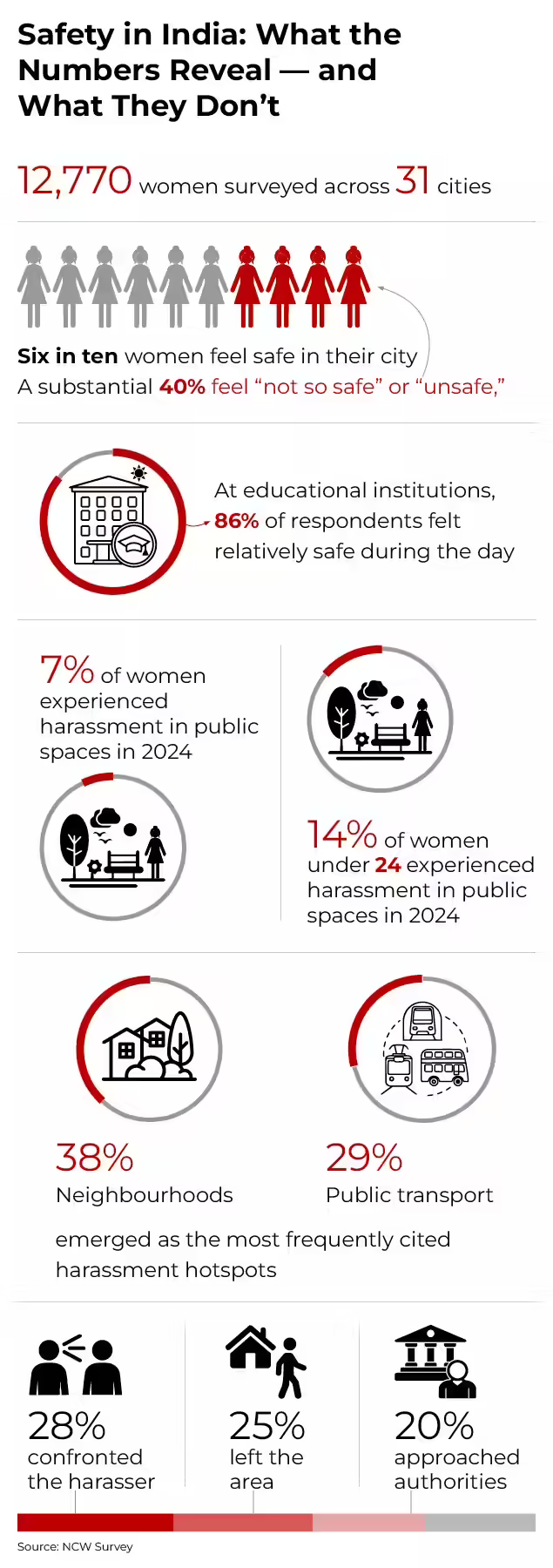
- Survey of 12,770 women across 31 cities
- Only 1 in 3 victims files a formal complaint
- Nearly 2/3 harassment cases go unreported
- Public transport (29%) and neighbourhoods (38%) identified as major hotspots
- 40% women still feel unsafe, despite improved reporting mechanisms
👉 Indicates a significant perception gap between safety claims and ground reality.
FIRs vs Actual Crime: Key Distinction
- Increase in FIRs does not necessarily mean increase in crime
- It may reflect:
- Better access to reporting mechanisms
- Increased awareness and legal empowerment
- Supreme Court mandates on compulsory FIR registration and digital complaint systems have improved reporting access
Thus, FIR data reflects institutional responsiveness, not necessarily crime incidence.
Policy Implications
- Need for survivor-centric data frameworks
- Incorporation of:
- Trauma indicators
- Long-term outcomes
- Perception-based surveys
- Strengthening:
- Police sensitivity and accountability
- Legal aid and fast-track justice systems
- Public awareness and social change initiatives
Way Forward
- Combine quantitative (crime data) with qualitative (survey-based insights)
- Promote safe reporting environments
- Address patriarchal structures and social stigma
- Enhance institutional trust and accessibility
Static Part (As per Input)
- Institution Mentioned: National Crime Records Bureau (NCRB)
- Function: Collection and publication of crime statistics in India
- Survey / Report Mentioned:
- National Commission for Women (NCW) Survey
- National Family Health Survey (NFHS-5, 2019–21)
- Key Functions:
- NCRB: Data collection, crime trend analysis
- NCW: Women’s rights protection, policy advocacy
- NFHS: Health and socio-economic indicators, including gender-based violence
Updated – 26 December 2025, 09:40 PM IST | News Source –Times of India