Fossil evidence of bamboo thorniness during Ice Age found in Manipur
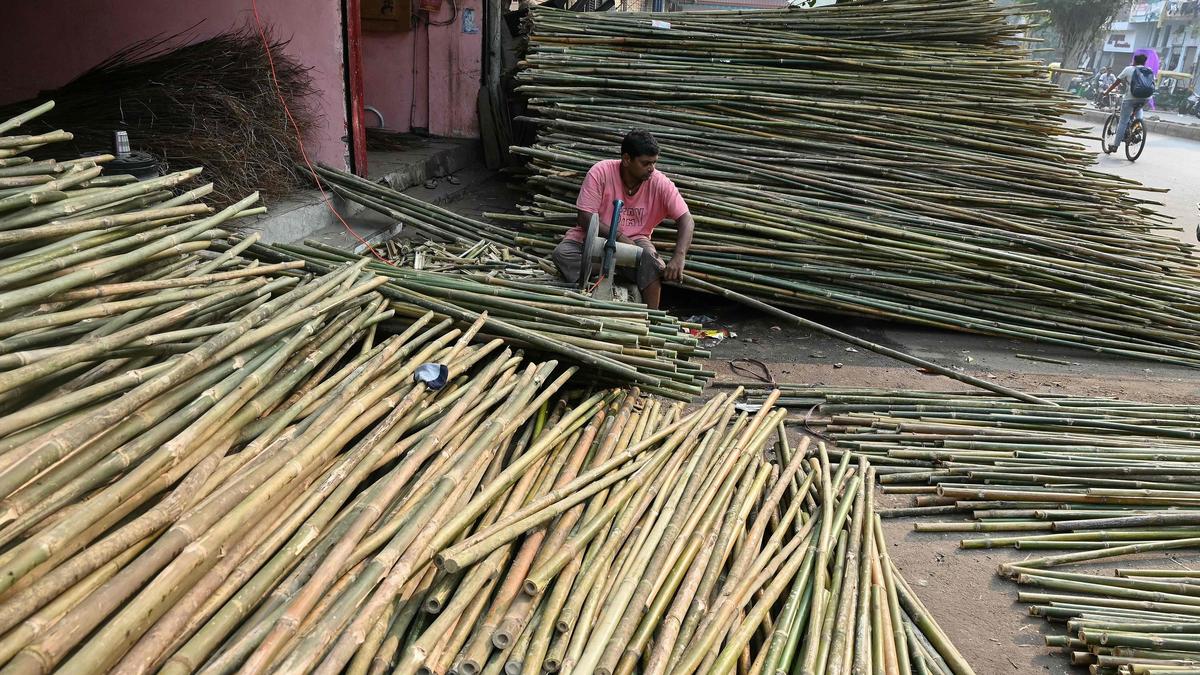
IN NEWS – Fossil evidence of bamboo thorniness during Ice Age found in Manipur
Why is Bamboo Thorniness Fossil Discovery in Manipur in News?
• Scientists discovered fossil evidence in Manipur indicating that thorniness in bamboo existed in Asia during the Ice Age.
• The fossil was found in silt-rich quaternary deposits along the Chirang River in Imphal Valley.
• It is the first known fossil proof that thorny bamboo survived the harsh Ice Age while disappearing from regions like Europe.
• The study highlights Northeast India as a biodiversity refuge during global climatic stress.
What is Bamboo Thorniness Fossil Discovery?
• A newly identified fossil of bamboo stem exhibiting thorn scars belonging to the genus Chimonobambusa.
• Fossil dates back to late Pleistocene sediments (Ice Age period).
• Its preservation is significant because thorn scars are delicate features that rarely fossilize.
Scientific Significance
• Reveals evolutionary defence mechanism of bamboo against herbivores existed during Ice Age.
• Indicates climatic resilience of bamboo in warm-humid Indo-Burma biodiversity region.
• Provides paleoclimatic evidence showing differential survival of bamboo species across continents.
Research Institutions Involved
• Birbal Sahni Institute of Palaeosciences (BSIP), under the Department of Science and Technology (DST).
• Geological Survey of India participated in fossil discovery during 2021-22 field surveys.
Comparative Analysis with Modern Bamboo
• Comparison with living thorny species like Bambusa bambos and Chimonobambusa callosa helped determine identity and morphology.
• Features studied include nodes, buds, and thorn scars for taxonomic classification.
Ecological Insights
• Indo-Burma hotspot acted as a refuge area during Ice Age.
• Bamboo extinction in Europe contrasts with its survival in Northeast India.
• Highlights the region's role in biodiversity conservation under climatic fluctuations.
Analysis
• Discovery contributes to understanding bamboo evolution and geographical survival patterns.
• Enhances palaeobotanical data aiding future climate modelling and vegetation shift studies.
• Strengthens the importance of protecting Northeast India's ecological zones as climate-safe biodiversity pockets.
Updated – 30 November 2025 ; 5: 20 PM | News Source: The Hindu