Scientists solve mystery of prehistoric ‘Burtele Foot’
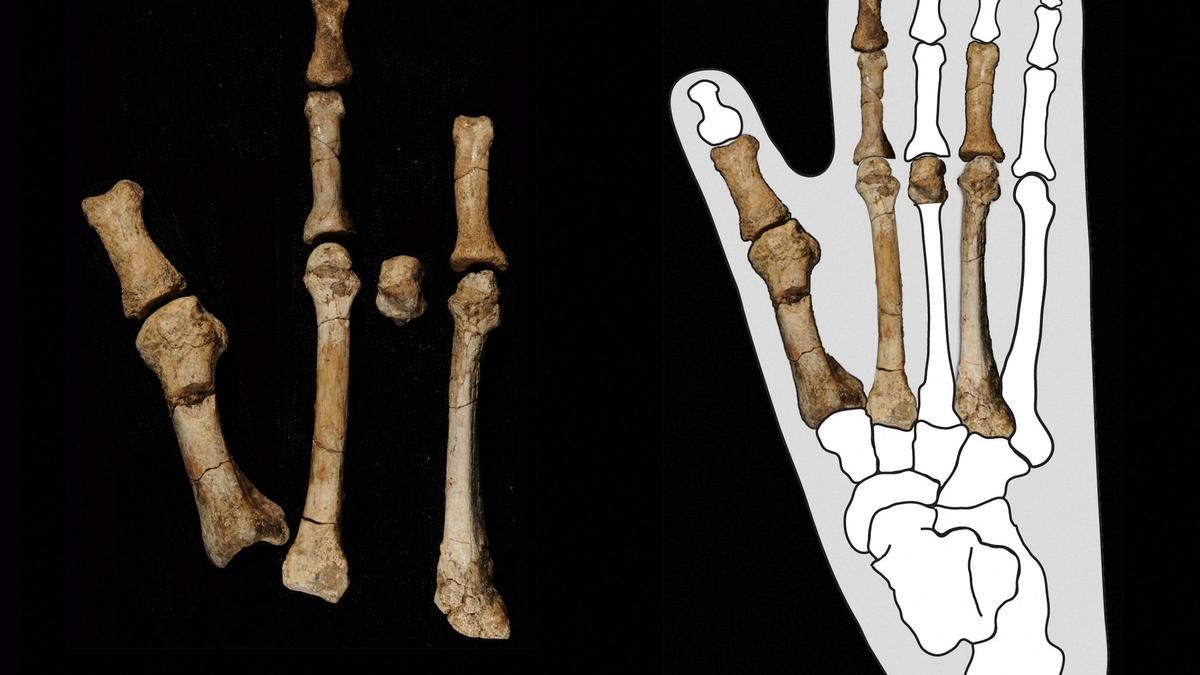
IN NEWS – Scientists solve mystery of prehistoric ‘Burtele Foot’
Why is Burtele Foot Discovery in News?
• Scientists have solved the long-standing mystery behind the 3.4-million-year-old Burtele Foot fossils discovered in Ethiopia in 2009.
• Recently found jawbone and 25 teeth of a 4.5-year-old child confirmed that the foot bones belonged to Australopithecus deyiremeda.
• Provides conclusive evidence that more than one human ancestor species lived concurrently between 3.5–3.3 million years ago.
• Newly published findings in the journal Nature deepen understanding of early hominin diversification.
What is Burtele Foot?
• A fossil consisting of eight foot bones found at Burtele site in the Afar Rift region of Ethiopia.
• Dated to about 3.4 million years old.
• Exhibits a combination of ape-like and human-like traits, including an opposable big toe.
Key Findings
• Belongs to Australopithecus deyiremeda, identified a decade earlier.
• Species was bipedal but maintained tree-climbing adaptation.
• Big toe was opposable, unlike Australopithecus afarensis (Lucy’s species).
• While walking, locomotion occurred using the second digit rather than the big toe.
• Indicates ecological niche differentiation and resource use variation between coexisting hominins.
Significance in Human Evolution
• Establishes non-linear evolutionary pattern with multiple hominin species existing simultaneously.
• Adds clarity to poorly understood phase of human lineage development.
• Provides evidence of diverse locomotor and dietary strategies among early hominins.
• Strengthens the hypothesis that bipedality evolved in stages with varied anatomical experimentation.
Comparative Traits
| Feature | Australopithecus deyiremeda | Australopithecus afarensis |
|---|---|---|
| Big toe | Opposable | Non-opposable |
| Locomotion | Bipedal + tree climbing | Efficient bipedal walking |
| Diet | Trees and shrubs | Broader diet including grasses |
| Adaptation | Better for climbing | Better for ground mobility |
Dietary Insights
• Chemical enamel analysis shows A. deyiremeda consumed tree and shrub-based food.
• A. afarensis had a wider dietary range, potentially giving evolutionary advantage.
Analysis
• Discovery reveals multiple evolutionary pathways existed, contradicting linear evolution assumptions.
• Distinct locomotor anatomy and niche specialization reduced direct competition.
• Helps reconstruct ecosystem, predator pressures, and adaptation responses of early hominins.
• Adds critical data for mapping behavioural evolution preceding Homo sapiens emergence.
Way Forward
• Further excavations in Afar Rift may uncover additional fossils linking locomotion with tool-use and social behaviour.
• Comparative genomic and morphological research could refine divergence timelines.
• Enhancing paleoenvironmental modelling will deepen understanding of hominin coexistence and resource strategies.
Updated – 30 November 2025 : 5: 45 PM | News Source: The Hindu