What is a superkilonova?
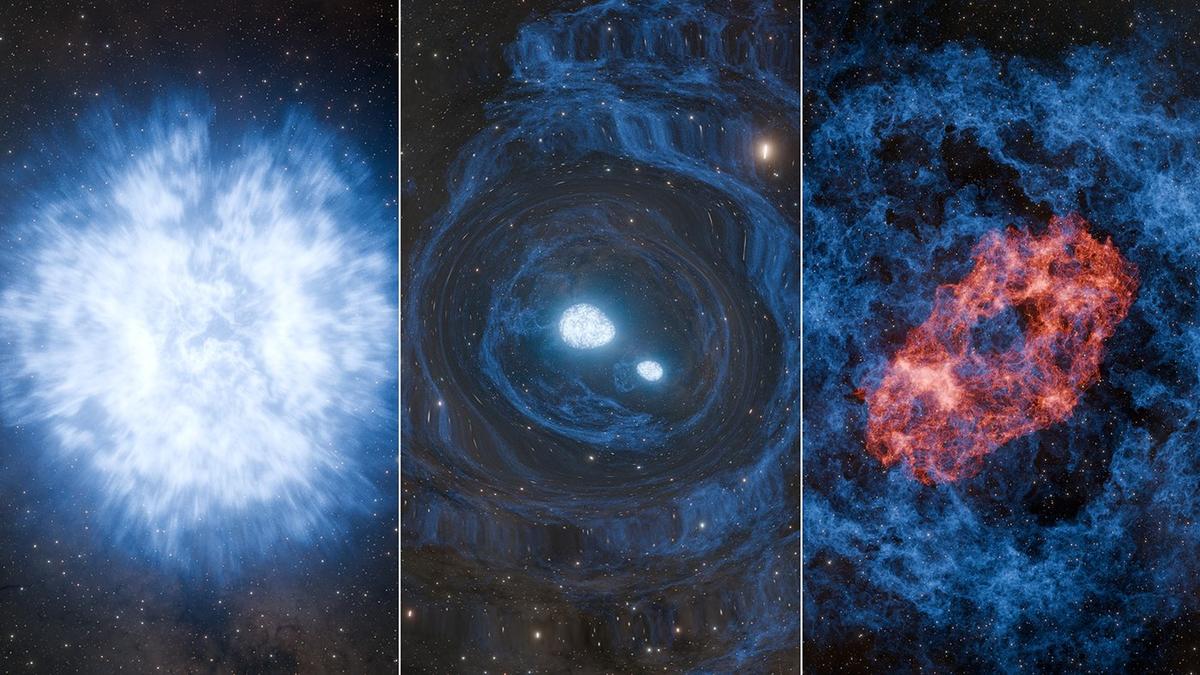
IN NEWS: Superkilonova
Analysis
Why Superkilonova Is in News?
- A recent international study reported observations of a possible superkilonova event about 1.3 billion light-years away.
- The study involved researchers from IIT Bombay and the Indian Institute of Astrophysics, Bengaluru.
- The findings were reported in The Hindu following publication of the study on 15 December 2025.
What Is a Superkilonova?
- A superkilonova is a rare and hypothetical cosmic explosion.
- It is related to, but more energetic than, a kilonova.
- A kilonova occurs when two neutron stars merge, ejecting matter rich in heavy radioactive elements such as gold, platinum and neodymium.
- The radioactive decay of these elements produces emissions in the optical and infrared spectrum.
Static Science Background (Astronomy)
What Is a Neutron Star?
- A neutron star is the collapsed core of a massive star after a supernova.
- It is extremely dense, composed primarily of neutrons.
- Neutron star mergers are among the strongest sources of gravitational waves.
How a Kilonova Occurs
- Two neutron stars orbit each other and eventually collide.
- The merger ejects neutron-rich material into space.
- This material undergoes rapid neutron capture (r-process), forming heavy elements.
- The decay of these elements produces a short-lived but intense glow called a kilonova.
How a Superkilonova Is Different
- A superkilonova has an additional energy source beyond radioactive decay.
- One proposed mechanism:
- Some ejected matter falls back toward the merged object.
- This fallback matter heats up and transfers energy to surrounding ejecta.
- The result is a brighter, bluer and longer-lasting emission than a normal kilonova.
- Another proposed scenario:
- A supernova explosion first forms two neutron stars.
- These neutron stars later merge, producing a kilonova.
- The combined energy output leads to a superkilonova-like signature.
Observational Evidence
- The observed event initially resembled a kilonova for about three days.
- Later, its light characteristics shifted and began to resemble a supernova.
- The brightness and spectral “fingerprint” matched predictions for a superkilonova.
- Astronomers emphasised that more such observations are needed to confirm the phenomenon conclusively.
Scientific Significance
- Helps improve understanding of:
- Formation of heavy elements in the universe
- Stellar evolution and death
- Extreme astrophysical explosions
- May bridge the observational gap between supernovae and kilonovae.
- Enhances multi-messenger astronomy involving light and gravitational waves.
Way Forward
- Collection of more observational data on similar cosmic events.
- Improved sky surveys and rapid follow-up observations.
- Integration of electromagnetic observations with gravitational-wave detectors.
- Refinement of theoretical models explaining neutron star mergers and stellar explosions.
Updated – 21 December 2025 ; 02:32 PM IST | News Source: The Hindu