ATOMS
Dalton’s Atomic Theory (1803–1808)
Dalton’s atomic theory was proposed by John Dalton between 1803 and 1808. It was the first scientific attempt to describe all matter in terms of atoms.According to this theory, matter consists of indivisible and indestructible particles called atoms. All atoms of a specific element are identical in mass and properties, and compounds are formed by combining atoms in simple, whole-number ratios.
Publication of Dalton’s Atomic Theory
In 1808, John Dalton published his atomic theory in his book “A New System of Chemical Philosophy.”The main axioms of Dalton’s atomic theory are as follows:
Axioms (Postulates) of Dalton’s Atomic Theory
- All matter is made up of small indivisible entities called atoms.
- All atoms of a particular element are identical in mass, size, and the rest of all other properties. However, atoms of different elements have different properties and vary in their mass and size.
- Atoms can neither be created nor destroyed. Atoms cannot be divided into simpler particles.
- Atoms of different elements can combine with each other in whole-number ratios in order to form compounds.
- Atoms participate in chemical reactions. Atoms can be rearranged, combined, or separated during a chemical reaction.
1. Rutherford and α-Particle Scattering Experiment
Ernst Rutherford (1871–1937), a former research student of J. J. Thomson, was engaged in experiments on α-particles emitted by some radioactive elements.In 1906, he proposed a classic experiment of scattering of these α-particles by atoms to investigate the atomic structure.This experiment was later performed around 1911 by Hans Geiger (1882–1945) and Ernst Marsden (1889–1970, who was a 20 year-old student and had not yet earned his bachelor’s degree).
2. Rutherford’s Nuclear Model of the Atom
Rutherford’s nuclear model was a major step towards how we see the atom today. However, it could not explain why atoms emit light of only discrete wavelengths.In Rutherford’s nuclear model of the atom, the entire positive charge and most of the mass of the atom are concentrated in the nucleus with the electrons some distance away.The electrons would be moving in orbits about the nucleus just as the planets do around the sun.
3. Failure of Classical Electromagnetic Theory
According to the classical electromagnetic theory, the frequency of the electromagnetic waves emitted by the revolving electrons is equal to the frequency of revolution.As the electrons spiral inwards, their angular velocities and hence their frequencies would change continuously, and so will the frequency of the light emitted.Thus, they would emit a continuous spectrum, in contradiction to the line spectrum actually observed.
4. Bohr’s Contribution and Quantum Hypothesis
It was Niels Bohr (1885–1962) who made certain modifications in this model by adding the ideas of the newly developing quantum hypothesis.Niels Bohr studied in Rutherford’s laboratory for several months in 1912 and he was convinced about the validity of Rutherford nuclear model.Faced with the dilemma as discussed above, Bohr, in 1913, concluded that in spite of the success of electromagnetic theory in explaining large-scale phenomena, it could not be applied to the processes at the atomic scale.It became clear that a fairly radical departure from the established principles of classical mechanics and electromagnetism was necessary.
5. Bohr’s Postulates
5.1 First Postulate (Stationary States)
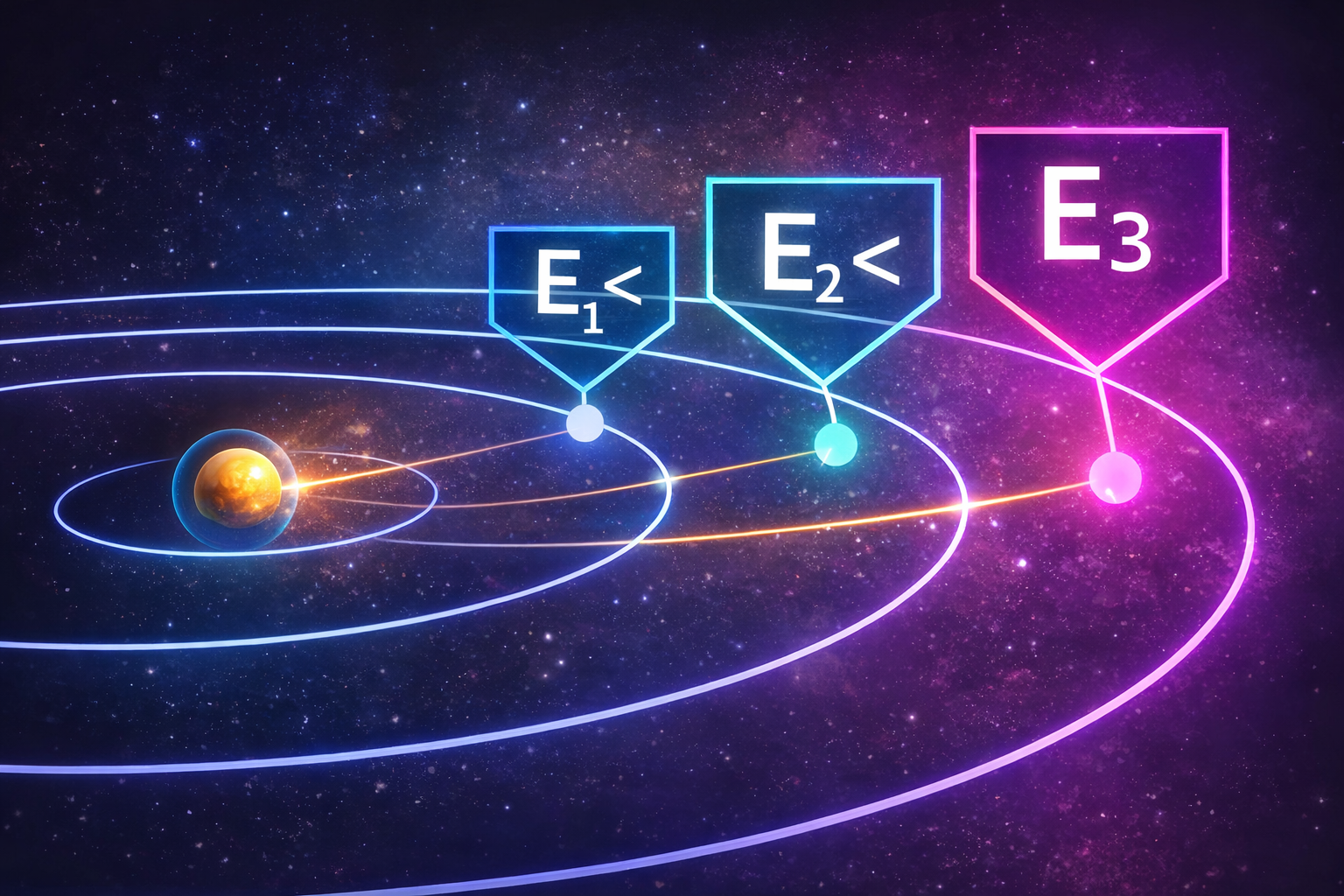
Bohr’s first postulate was that an electron in an atom could revolve in certain stable orbits without the emission of radiant energy, contrary to the predictions of electromagnetic theory.According to this postulate, each atom has certain definite stable states in which it can exist, and each possible state has definite total energy.These are called the stationary states of the atom.
5.2 Second Postulate (Quantisation of Angular Momentum)
Bohr’s second postulate defines these stable orbits.This postulate states that the electron revolves around the nucleus only in those orbits for which the angular momentum is some integral multiple of h/2π, where h is the Planck’s constant (= 6.6 × 10⁻³⁴ J s).Thus, the angular momentum (L) of the orbiting electron is quantised, that is
L = nh/2π.
5.3 Third Postulate (Emission of Radiation)
Bohr’s third postulate incorporated into atomic theory the early quantum concepts that had been developed by Planck and Einstein.It states that an electron might make a transition from one of its specified non-radiating orbits to another of lower energy.When it does so, a photon is emitted having energy equal to the energy difference between the initial and final states.The frequency of the emitted photon is then given by
hν = Ei − Ef.
6. de Broglie’s Hypothesis and Experimental Verification
About the de Broglie’s hypothesis that material particles, such as electrons, also have a wave nature.C. J. Davisson and L. H. Germer later experimentally verified the wave nature of electrons in 1927.
7. Success of Bohr’s Model
Bohr’s model, involving classical trajectory picture (planet-like electron orbiting the nucleus), correctly predicts the gross features of the hydrogenic atoms, in particular, the frequencies of the radiation emitted or selectively absorbed.
8. Limitations of Bohr’s Model
8.1 Limitation for Multi-Electron Atoms
This model however has many limitations. Some are:The Bohr model is applicable to hydrogenic atoms. It cannot be extended even to mere two electron atoms such as helium.The analysis of atoms with more than one electron was attempted on the lines of Bohr’s model for hydrogenic atoms but did not meet with any success.Difficulty lies in the fact that each electron interacts not only with the positively charged nucleus but also with all other electrons.The formulation of Bohr model involves electrical force between positively charged nucleus and electron. It does not include the electrical forces between electrons which necessarily appear in multi-electron atoms.
8.2 Intensity of Spectral Lines
While the Bohr’s model correctly predicts the frequencies of the light emitted by hydrogenic atoms, the model is unable to explain the relative intensities of the frequencies in the spectrum.In emission spectrum of hydrogen, some of the visible frequencies have weak intensity, others strong. Why?Experimental observations depict that some transitions are more favoured than others.Bohr’s model is unable to account for the intensity variations.
Important Atomic Theory Developments (Chronological Table)
| Scientist | Year | Experiment / Theory | Key Contribution |
|---|---|---|---|
| John Dalton | 1808 | Dalton’s Atomic Theory | Proposed that matter is composed of indivisible atoms. Atoms of the same element are identical, and compounds are formed by simple whole-number ratios of atoms. |
| Ernest Rutherford, Hans Geiger, Ernest Marsden | 1909–1911 | α-Particle Scattering Experiment | Studied scattering of α-particles by thin metal foil. Led to the discovery of a small, dense, positively charged nucleus. |
| Ernest Rutherford | 1911 | Nuclear Model of Atom | Proposed that most of the mass and positive charge of the atom are concentrated in the nucleus, with electrons revolving around it. |
| Niels Bohr | 1913 | Bohr’s Atomic Model and Postulates | Introduced quantised energy levels and stable orbits to explain the discrete line spectrum of hydrogen. |
| Louis de Broglie | 1924 | de Broglie’s Hypothesis | Proposed wave nature of matter. Suggested that particles like electrons have wavelength λ = h/p. |
| Clinton Davisson & Lester Germer | 1927 | Electron Diffraction Experiment | Experimentally verified the wave nature of electrons through diffraction. |
| G. P. Thomson | 1927 | Electron Diffraction | Independently confirmed the wave nature of electrons using thin metal foils. |