Bhakti Movement in Early Medieval India [ NCERT ]
Bhakti Movement & Religious Developments in Medieval India
1. Background: Idea of a Supreme God
- In early societies, different groups worshipped different gods and goddesses.
- With the growth of towns, trade, and empires, religious ideas evolved.
Key Developments
- Cycle of birth and rebirth (Samsara) became widely accepted.
- Belief developed that people are unequal by birth due to caste hierarchy.
- Social privileges were linked to “high caste” or noble birth.
- These ideas were justified in Brahmanical texts.
Reaction Against Social Inequality
Many people rejected these ideas and turned to:
- Buddhism
- Jainism
- Bhakti tradition
Common belief:
- Salvation possible through personal effort or devotion.
2. Rise of Bhakti
Meaning of Bhakti
- Bhakti = devotion to a personal god.
- Open to all people regardless of caste, gender or wealth.
Early Text Reference
- The idea of bhakti is present in the Bhagavad Gita.
Major Deities Worshipped
- Shiva
- Vishnu
- Durga
Role of Puranas
- Puranas
- Integrated local gods into mainstream Hinduism
- Provided rituals and stories
- Promoted the idea that God’s grace is available to everyone
Influence
- Even Buddhists and Jainas adopted devotional practices later.
3. Bhakti in South India
Nayanars and Alvars (7th–9th Century)
Nayanars
- Devotees of Shiva
- Total number: 63 saints
- Came from all castes including “untouchables”
Important Nayanars:
- Appar
- Sambandar
- Sundarar
- Manikkavasagar
Texts:
- Tevaram
- Tiruvacakam
Alvars
- Devotees of Vishnu
- Total number: 12 saints
Important Alvars:
- Periyalvar
- Andal
- Tondaradippodi Alvar
- Nammalvar
Texts:
- Divya Prabandham
Key Features
- Travelled village to village
- Composed devotional hymns in Tamil
- Combined Sangam literary ideals with Bhakti
Political Support
Between 10th–12th centuries:
- Chola Dynasty
- Pandya Dynasty
They:
- Built large temples
- Compiled bhakti hymns
- Promoted temple worship.
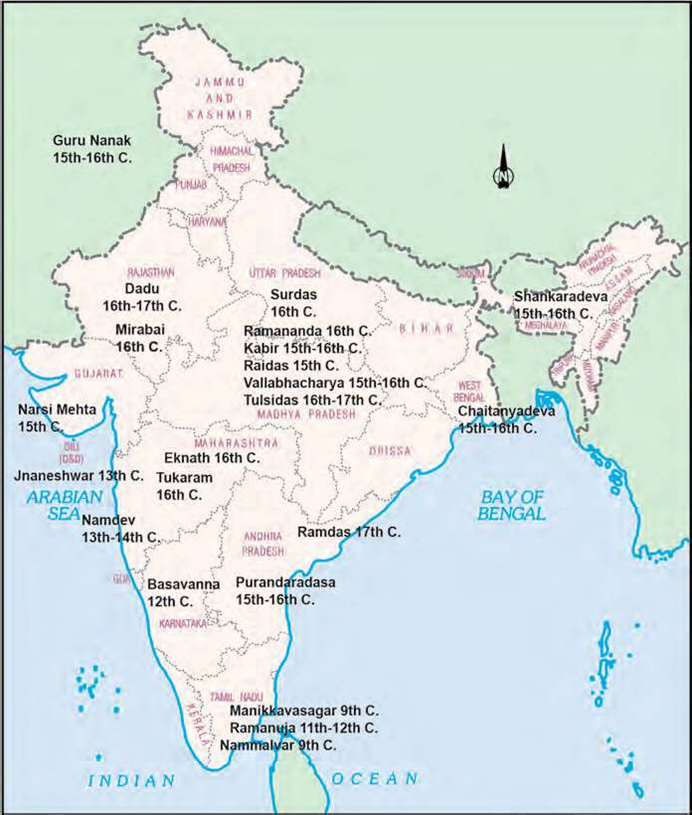
4. Philosophical Developments
Adi Shankaracharya
- Adi Shankaracharya
- Born in Kerala (8th century)
Doctrine: Advaita VedantaMain Ideas:
- Brahman is the ultimate reality
- Brahman is formless and attribute-less
- World is Maya (illusion)
- Salvation through knowledge (Jnana) and renunciation.
Ramanuja
- Ramanuja
- Born in Tamil Nadu (11th century)
Doctrine: VishishtadvaitaMain Ideas:
- Devotion to Vishnu leads to salvation
- Soul remains distinct even after union with God
- Strongly influenced later North Indian Bhakti.
5. Basavanna and Virashaivism
Leader:
- Basavanna
Movement:
- Virashaiva / Lingayat movement
- Began in 12th century Karnataka
Key Features:
- Equality of all humans
- Rejection of:
- caste system
- Brahmanical rituals
- idol worship
- Religious sayings called Vachanas.
Important Followers:
- Allama Prabhu
- Akkamahadevi
1. Kudala Sangama: Important Lingayat Pilgrimage Centre
Kudalasangama is an important pilgrimage centre of the Lingayat tradition in southern India. It is located in Bagalkot district of Karnataka, about 15 km from the Almatti Dam. The site is geographically significant because it is located at the confluence of the Krishna and Malaprabha rivers, which later flow eastward towards Srisailam, another major religious centre. The place holds immense religious importance for the followers of Lingayatism, as it is associated with the great social reformer Basavanna.
2. Religious Significance of Kudala Sangama
Kudala Sangama is revered as the spiritual centre of the Lingayat movement. The site contains the Aikya Mantapa, which is believed to be the holy samadhi (final resting place) of Basavanna. The temple complex also houses a self-manifested (Swayambhu) Shiva Linga, which is worshipped by devotees. Because of these sacred associations, the place attracts large numbers of pilgrims from Karnataka and other parts of India. The development and maintenance of the pilgrimage site are managed by the Kudala Sangama Development Board. Historically, the site has remained a significant religious and cultural centre for more than 800 years, highlighting its importance in the evolution of the Lingayat religious tradition.
3. Vachana Literature and the Sharana Movement
The Vachanas represent a unique 12th-century form of Kannada devotional literature composed during the Lingayat social and religious movement in Karnataka. The term Vachana literally means “that which is spoken”, indicating their simple, direct, and oral style. These compositions were written in rhythmic free-verse poetry and were intended to convey spiritual truths and social reform ideas in a language easily understood by common people.The Vachanas were composed by saint-poets known as Sharanas, prominent among whom were Basavanna, Akka Mahadevi, and Allama Prabhu. Their writings emphasised devotion to Lord Shiva, ethical living, rejection of caste hierarchy, equality of men and women, and criticism of ritualistic Brahmanical practices.
4. Social and Religious Impact of the Vachana Movement
The Vachana movement was not merely a literary development but a powerful social and religious reform movement in medieval Karnataka. The Sharanas promoted egalitarian ideals, questioning caste discrimination, social inequality, and excessive rituals. Their teachings emphasised personal devotion to Shiva, moral conduct, and social responsibility. By using simple Kannada language instead of Sanskrit, the Vachanas made spiritual ideas accessible to the common people, thereby transforming the religious and cultural landscape of the region.
Thus, Kudalasangama stands as an important historical and religious centre of the Lingayat tradition, closely linked with the teachings of Basavanna. The Vachana literature produced by the Sharanas played a crucial role in promoting social equality, spiritual devotion, and reformist ideas, making it a significant chapter in the Bhakti movement and the socio-religious history of India.
6. Bhakti in Maharashtra
Major Saints:
- Dnyaneshwar
- Namdev
- Eknath
- Tukaram
- Women saints: Sakhubai
Key Centre
- Pandharpur
Main deity:
- Vitthala (form of Vishnu)
Core Ideas
- Rejection of ritualism
- Opposition to caste hierarchy
- Emphasis on:
- humility
- service to humanity
- devotion through daily life
Literary form:
- Abhang (Marathi devotional hymns).
7. Nathpanthis, Siddhas and Yogis
Key Characteristics:
- Criticised Brahmanical rituals
- Popular among lower castes
Beliefs:
- Salvation through meditation
- Emphasis on formless reality
Practices:
- Yoga
- breathing exercises
- meditation
- control of body and mind.
8. Islam and Sufism
Core Belief
- Strict monotheism: belief in one God.
Islamic Law
- Developed by scholars as Shariat.
Sufism
Sufis emphasized:
- Love and devotion to God
- Compassion toward humanity
- Rejection of excessive rituals.
Training Methods:
- Zikr (chanting)
- meditation
- music and dance
- spiritual guidance of a Pir (master)
Famous Sufi Saints
- Al-Ghazali
- Jalaluddin Rumi
- Saadi Shirazi
Major Sufi Orders in India
Chishti Order
Important Saints:
- Moinuddin Chishti
- Qutbuddin Bakhtiar Kaki
- Baba Farid
- Nizamuddin Auliya
- Bandanawaz Gisudaraz
| Sufi Saint | Place / Region | Present Country | Key Title / Identity | Important Points |
|---|---|---|---|---|
| Moinuddin Chishti | Ajmer | India | Gharib Nawaz (Benefactor of the Poor) | Founder and most influential propagator of the Chishti Order in India; Dargah at Ajmer is a major pilgrimage centre. |
| Qutbuddin Bakhtiar Kaki | Mehrauli | India | Early Chishti Saint of Delhi | Disciple of Moinuddin Chishti; helped establish Delhi as a major Sufi centre. |
| Fariduddin Ganjshakar | Pakpattan | Pakistan | Baba Farid / Ganj-e-Shakar | Famous Punjabi Sufi saint; verses included in Guru Granth Sahib. |
| Nizamuddin Auliya | Nizamuddin | India | Famous Chishti Saint | Preached universal love and compassion; spiritual guide of Amir Khusrau. |
| Bande Nawaz Gesudaraz | Kalaburagi (Gulbarga) | India | Deccan Chishti Saint | Spread the Chishti order in the Deccan; important Sufi literary works. |
Key Institution:
- Khanqah (Sufi hospice)
Shrines of saints became major pilgrimage centres.
9. Bhakti Movement in North India
Period:
13th – 17th centuriesContext:
- Interaction between:
- Islam
- Brahmanical traditions
- local devotional traditions.
New social groups participating:
- artisans
- traders
- peasants
- labourers.
10. Important North Indian Saints
Kabir
- Kabir
- Raised in a weaver family in Varanasi
Teachings:
- Rejected both Hindu and Muslim orthodoxy
- Opposed:
- caste system
- priestly authority
- ritualism
Belief:
- God is formless
- True devotion lies within the heart.
Language:
- Simple Hindi dialect
Guru Nanak
- Guru Nanak
- Born at Nankana Sahib (1469)
Key Principles:
- Worship of one God
- Equality of all humans
- Honest living and social service.
Institutions:
- Langar (community kitchen)
- Gurdwara
Scripture:
- Guru Granth Sahib
Successor:
- Guru Angad
Later Development:
- Guru Gobind Singh
- founded Khalsa in 1699
11. Other Bhakti Saints
Tulsidas
- Tulsidas
- Wrote Ramcharitmanas
Surdas
- Surdas
- Work: Sursagar
Chaitanyadeva
- Chaitanya Mahaprabhu
- Promoted Krishna-Radha devotion
Shankaradeva
- Srimanta Sankardev
- Founded Namghar (prayer halls).
Mirabai
- Mirabai
- Rajput princess devoted to Krishna
- Challenged social norms and caste hierarchy.
12. Key Characteristics of Bhakti Movement
Religious
- devotion to personal god
- rejection of ritualism
- stress on inner spirituality
Social
- opposed caste discrimination
- promoted equality
Cultural
- use of regional languages
- songs and poetry spread orally.
Political Impact
- created large devotional communities
- influenced regional cultures and identities.
| Saint / Thinker | Period (Approx.) | Region | Key Idea / Contribution |
|---|---|---|---|
| Adi Shankaracharya | 8th century CE | Kerala | Advaita Vedanta, Brahman is ultimate reality |
| Nammalvar | 9th century CE | Tamil Nadu | Alvar saint, devotion to Vishnu |
| Mannikavasagar | 9th CE | ||
| Nathamuni | 9th–10th century | Tamil Nadu | Collected Divya Prabandham |
| Ramanujacharya | 1017–1137 | Tamil Nadu | Vishishtadvaita philosophy |
| Basavanna | 1131 CE | Karnataka | Anti-caste, equality, Bhakti |
| Namdev | 1270–1350 | Maharashtra | Devotion to Vitthal |
| Dnyaneshwar | 1275–1296 | Maharashtra | Bhakti in Marathi, Bhagavad Gita commentary |
| Ramananda | 1290-1410 | Varanasi | Spread Ram Bhakti in North India |
| Ravidas | 1377-1527 | ||
| Kabir | 1398–1518 | Varanasi | Nirguna Bhakti, opposed caste & ritualism |
| Narsi Mehta | 1414-1488 | ||
| Shankaradeva | 1449-1568 | Assam | Neo-Vaishnavism in Assam |
| Guru Nanak | 1469–1539 | Punjab | Founder of Sikhism, equality & devotion |
| Vallabhacharya | 1479–1531 | Varanasi / Gujarat | Shuddhadvaita philosophy |
| Surdas | 1483-1583 | ||
| Purandardasa | 1484-1564 | Karnataka | |
| Chaitanya Mahaprabhu | 1486–1534 | Bengal | Krishna Bhakti, Sankirtan movement |
| Mirabai | 1498–1546 | Rajasthan | Devotion to Krishna |
| Tulsidas | 1511 | Uttar Pradesh | Ram Bhakti, Ramcharitmanas |
| Eknath | 1533–1599 | Maharashtra | Bhakti literature in Marathi |
| Dadu Dayal | 1544–1603 | Rajasthan | Equality and devotion |
| Tukaram | 1598–1650 | Maharashtra | Devotion to Vitthal |
| Ramdas | 1608–1681 | Maharashtra | Spiritual guide of Shivaji |