AI, skilling and creative economy push in Union Budget 2026–27
AI, skilling and creative economy push in Union Budget 2026–27
Introduction
The Union Budget 2026–27 emphasizes Artificial Intelligence (AI), emerging technologies, skilling, and creative industries as key drivers of India’s future growth. With initiatives like Bharat-VISTAAR, AVGC labs, and a high-powered standing committee, the Budget aims to integrate technology with agriculture, education, and employment generation, aligning with the goal of inclusive and capacity-driven development.
ANALYSIS
The Budget reflects a comprehensive technology-led development strategy, integrating AI, education, agriculture, and creative industries to enhance productivity, employment, and innovation.
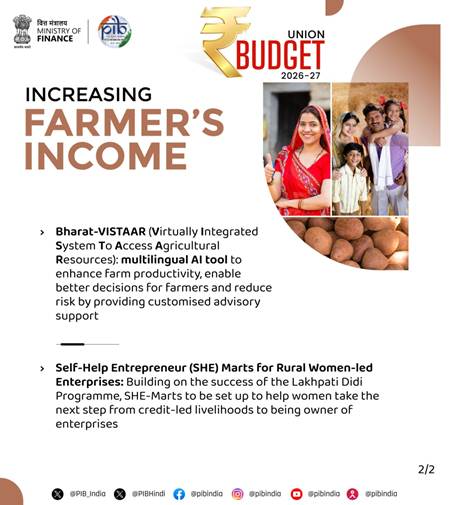
A major initiative is Bharat-VISTAAR (Virtually Integrated System to Access Agricultural Resources), a multilingual AI tool designed to integrate AgriStack and ICAR agricultural practices. This initiative aims to improve farm productivity, enhance farmer decision-making, and reduce risks through customised advisory services, marking a shift towards precision agriculture and data-driven farming.
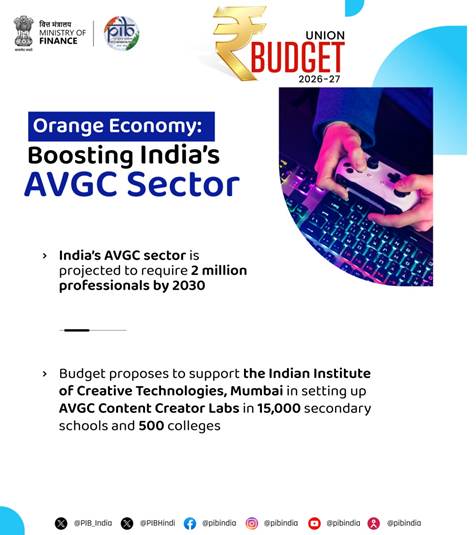
In the education and creative sector, the establishment of AVGC (Animation, Visual Effects, Gaming, and Comics) Content Creator Labs in 15,000 schools and 500 colleges represents a significant push towards the Orange Economy, which focuses on creative industries. With the AVGC sector projected to require 2 million professionals by 2030, this initiative addresses the skill gap and future workforce demand in digital content and media industries.
The proposal to set up a new National Institute of Design (NID) in Eastern India highlights the growing importance of the design industry in economic development, promoting innovation, product development, and global competitiveness.
Recognising the disruptive impact of AI on employment, the Budget proposes a High-Powered ‘Education to Employment and Enterprise’ Standing Committee. This committee will assess the impact of emerging technologies on jobs and skill requirements and recommend strategies for reskilling, upskilling, and workforce transition, ensuring alignment between education systems and industry needs.
The Budget also reinforces support through broader initiatives like AI Mission, National Quantum Mission, Anusandhan National Research Fund, and RDI Fund, indicating a holistic ecosystem approach to research, innovation, and technological advancement.
Overall, the policy framework demonstrates a multi-sectoral integration of technology, focusing on agriculture modernisation, skill development, creative economy expansion, and future workforce readiness, which are critical for achieving long-term economic transformation and global competitiveness.
Implications
- Promotes AI-driven agriculture and precision farming
- Strengthens creative economy and digital content industries (AVGC)
- Enhances skill development and employability in emerging sectors
- Aligns education system with future job requirements
- Supports transition towards a technology-driven and innovation-led economy
Static Part
Institution: Ministry of Finance
- Function: Budget formulation, fiscal policy, and economic planning
Key Initiatives Mentioned
- Bharat-VISTAAR: AI-based agricultural advisory platform integrating AgriStack and ICAR
- AVGC Labs: Skill development infrastructure in creative industries
- National Institute of Design (NID): Design education and innovation
- Education to Employment and Enterprise Committee: Policy advisory on jobs and skills
Related Missions
- AI Mission
- National Quantum Mission
- Anusandhan National Research Fund
- Research, Development and Innovation Fund
Updated - 01 February 2026; 01:29 PM | PIB