India Improves to 15th in Global FDI Rankings: Insights from UNCTAD Report
India Improves to 15th in Global FDI Rankings: Insights from UNCTAD Report
Introduction
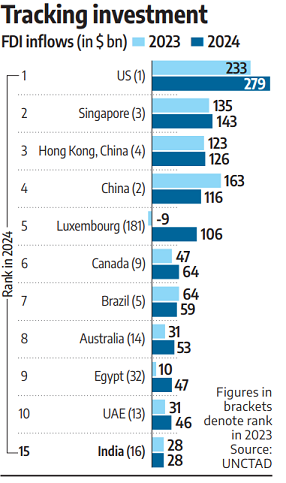
According to the World Investment Report 2025 released by United Nations Conference on Trade and Development, India improved its position to 15th globally in Foreign Direct Investment (FDI) inflows in 2024, up from 16th in 2023. Despite this rise, FDI inflows slightly declined to around $27.6–28 billion, reflecting broader global investment slowdown trends.
Global Context and India’s Position
The report highlights a global decline of 11% in FDI flows, indicating tightening financial conditions and geopolitical uncertainties. In this scenario, India’s improved ranking suggests relative resilience.
- Top global destinations:
- United States (1st)
- Singapore (2nd)
- Hong Kong (3rd)
- China slipped to 4th
India continues to be the top FDI destination in South Asia and a key player among developing economies.
Key Trends in India’s FDI Performance
1. Stability Amid Decline
- FDI inflows remained stable (~$28 billion) despite global contraction
- Slight YoY decline (~1.9%) indicates moderate investor caution
2. Rise in Greenfield Investments
- India ranked 4th globally in greenfield project announcements
- Capital expenditure in such projects rose significantly:
- ~$110 billion projected investments
- Strong sectors:
- Digital services
- Semiconductors
- Basic metals
3. Divergence in Investment Types
| Investment Type | Trend |
|---|---|
| Greenfield Projects | Strong growth |
| International Project Finance (IPF) | Decline (India slipped to 5th) |
| Mergers & Acquisitions | Weak in developing Asia |
This reflects a shift towards long-term industrial investments rather than financial deals.
Sectoral and Regional Insights
- India attracted $54 billion in digital sector investments (2020–2024)
- Major investments include:
- Expansion of Cloud & AI infrastructure (e.g., Microsoft)
- Renewable energy sector driving project concentration along with countries like Brazil and Chile
India accounts for nearly one-third of Asia’s projected capital expenditure, highlighting its role as a manufacturing and digital hub.
Economic Implications
Positive Signals
- Improved ranking despite global slowdown
- Strong greenfield investments → job creation & industrial growth
- Growing digital economy attractiveness
- Indicates maturing investment market (as noted by RBI due to repatriation trends)
Concerns
- Decline in net FDI due to repatriation
- Weak performance in infrastructure financing (IPF deals)
- Dependence on few sectors (digital, metals)
Challenges and Limitations
- Global uncertainties: geopolitical tensions, high capital costs
- Regulatory bottlenecks affecting ease of doing business
- Limited diversification of FDI sectors
- Declining cross-border M&A activity
Way Forward
- Enhance ease of doing business reforms
- Boost infrastructure financing ecosystem
- Diversify into high-tech manufacturing sectors
- Promote stable policy regime for investors
- Strengthen domestic value chains and export competitiveness
Conclusion
India’s rise to the 15th position in global FDI rankings amid a global downturn reflects its relative economic resilience and growing attractiveness as an investment destination. However, sustaining this momentum requires addressing structural challenges and ensuring balanced growth across sectors and investment types.
STATIC PART
United Nations Conference on Trade and Development (UNCTAD)
- Established: 1964
- Headquarters: Geneva, Switzerland
- Parent Body: United Nations
- Key Functions:
- Promotes trade, investment, and development
- Publishes World Investment Report
- Provides policy analysis for developing countries
World Investment Report
- Published by: UNCTAD
- Focus Areas:
- Global FDI trends (inflows & outflows)
- Greenfield investments
- Cross-border mergers & acquisitions
- International project finance
Updated - 19 June 2025 | 10:10 PMNews Source: Business Standard