EU Considers Emergency Measures Amid Druzhba Pipeline Disruption
EU Considers Emergency Measures Amid Druzhba Pipeline Disruption
Introduction
The European Commission is engaging with Ukraine to restore oil flows through the Druzhba Pipeline, disrupted since January 2026. The halt has impacted supplies to Hungary and Slovakia, raising concerns over energy security, geopolitical tensions, and EU sanctions dynamics.
Background: Strategic Importance of Druzhba Pipeline
The Druzhba (Friendship) Pipeline is one of the world’s longest oil pipeline networks, transporting Russian crude oil to Central and Eastern Europe. It is crucial for landlocked countries like Hungary and Slovakia that depend heavily on pipeline imports.
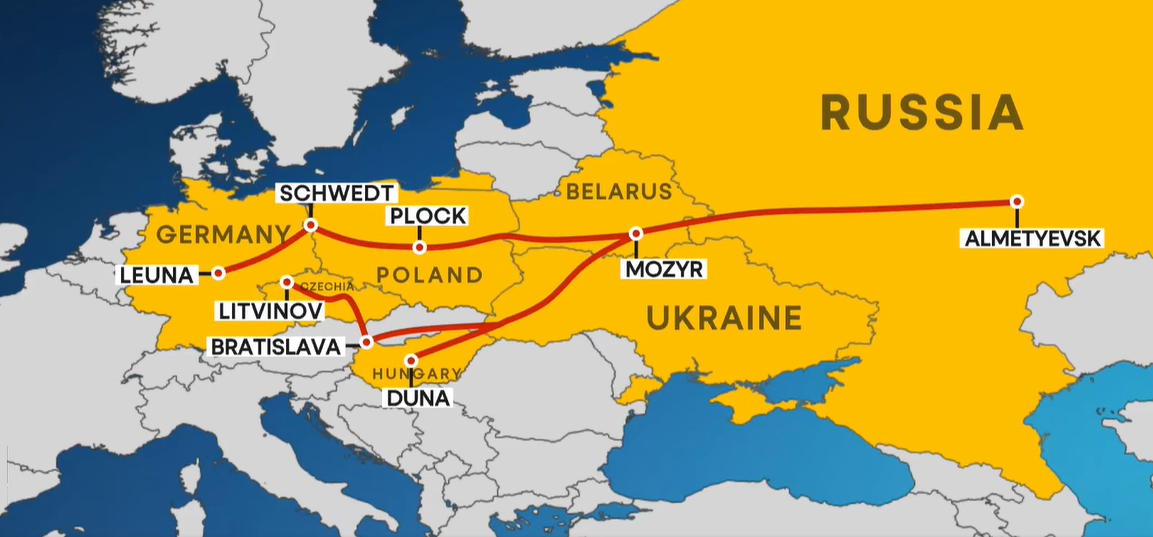
Current Crisis and Developments
The disruption reportedly began after a drone attack, though political allegations have surfaced:
- Slovakia accused Ukraine of deliberately delaying restoration to exert pressure regarding EU membership.
- Ukraine attributes the disruption to security-related damage.
- The European Commission clarified:
- No immediate supply risk due to 90-day reserve stocks.
- Preparedness to activate emergency coordination mechanisms.
Geopolitical Tensions and Energy Politics
The crisis highlights a complex intersection of energy security and geopolitics:
- Robert Fico termed the delay as “political blackmail”.
- Hungary explored alternative supply via Adria Pipeline through Croatia.
- Croatia signaled readiness but criticized continued dependence on Russian oil.
This reflects the broader EU dilemma between sanctions enforcement vs. energy dependence.
EU Sanctions and Exemptions
- The EU imposed a ban on Russian oil imports, but:
- Hungary and Slovakia received temporary exemptions due to geographical constraints.
- Debate is intensifying on:
- Whether these exemptions should continue.
- Their impact on EU unity and sanctions credibility.
Alternative Supply Mechanisms
Efforts to mitigate disruption include:
- Use of the Adria Pipeline via Croatia for seaborne crude.
- Strategic oil reserves (90 days buffer).
- Potential diversification towards non-Russian sources.
Think Tank Perspective: Energy Security Debate
A report by Center for the Study of Democracy argued:
- Hungary no longer needs Russian oil.
- Continued dependence is a policy choice, not necessity.
- Recommended:
- Phasing out exemptions by 2026
- Strengthening long-term EU energy resilience
Implications
- Energy Security: Highlights vulnerability of pipeline-dependent nations.
- Geopolitics: Energy supply being used as a strategic tool.
- EU Cohesion: Divergence between member states on Russian oil dependence.
- Sanctions Regime: Questions effectiveness and uniformity.
Way Forward
- Accelerate energy diversification strategies.
- Strengthen infrastructure for alternative routes.
- Enhance regional cooperation mechanisms.
- Gradual phase-out of Russian energy dependence.
Conclusion
The Druzhba pipeline disruption underscores the fragile balance between energy security and geopolitical strategy in Europe. While short-term supply risks are contained, the episode reinforces the urgency for the EU to reduce dependency on Russian energy and ensure long-term resilience.
Static Part
Key Institutions
- European Commission
- Role: Executive body of the EU
- Function: Policy implementation, coordination, crisis response
- Center for the Study of Democracy
- Nature: Policy research institution
- Focus: Energy security, governance, economic policy
Important Infrastructure
| Pipeline | Function |
|---|---|
| Druzhba Pipeline | Supplies Russian oil to Europe |
| Adria Pipeline | Alternative route via Croatia |
Updated - 18 February 2026 | 11:30 AM | News Source: OilPrice